Appearance
11.10 — φ: The Golden Ratio, and What Is True About It
Take a stick and cut it into two pieces, one longer and one shorter. There is one special place to cut it. The ancient Greek mathematician Euclid described it around 300 BCE, in Book VI of his famous geometry book, the Elements.
1. The special cut
What a ratio is
A ratio compares two lengths by dividing one by the other. If one stick is 6 cm and another is 3 cm, the ratio of the first to the second is 6 \div 3 = 2. The first is twice as long.
Euclid's rule
Euclid's rule for the special cut, in plain words, is:
The whole stick compared with the long piece should be the same as the long piece compared with the short piece.
Euclid called this cutting a line "in extreme and mean ratio". Today we call it the golden cut.

Trying some cuts
Let us test some cuts on a stick 10 cm long, to see what the rule asks for.
| Long piece | Short piece | Whole ÷ long | Long ÷ short | Equal? |
|---|---|---|---|---|
| 5 | 5 | 2.0 | 1.0 | no |
| 7 | 3 | 1.43 | 2.33 | no |
| 6 | 4 | 1.67 | 1.5 | no |
| 6.2 | 3.8 | 1.613 | 1.632 | nearly |
Cutting in the middle gives 2 on the left and 1 on the right. Cutting at 7 overshoots the other way. Somewhere around 6.18 cm the two ratios become exactly equal. That shared ratio is the number we are after. It is called the golden ratio, and it is written with the Greek letter \varphi, "phi", read "fie" or "fee".
Working out its exact value
Call the long piece a and the short piece b. Then the whole stick is a + b. Euclid's rule says:
\frac{a + b}{a} = \frac{a}{b}
The rule is only about the shape of the cut, not its size. A long stick cut this way and a short stick cut this way give the same ratios. So we are free to choose a convenient size. Let us make the short piece exactly 1 long: b = 1.
Then the long piece divided by the short piece is just a \div 1 = a. So a is the golden ratio. Let us call it \varphi from now on. The rule becomes:
\frac{\varphi + 1}{\varphi} = \varphi
Now solve it, one step at a time.
Step 1. Clear the bottom. Multiply both sides by \varphi:
\varphi + 1 = \varphi \times \varphi = \varphi^2
Step 2. Gather the \varphi's on one side. Take \varphi from both sides:
\varphi^2 - \varphi = 1
Step 3. Make the left side a perfect square. This is a standard trick called completing the square (Chapter 2.3). Notice that \left(\varphi - \frac12\right)^2, multiplied out, is:
\left(\varphi - \tfrac12\right)\left(\varphi - \tfrac12\right) = \varphi^2 - \tfrac12\varphi - \tfrac12\varphi + \tfrac14 = \varphi^2 - \varphi + \tfrac14
That is our left side, \varphi^2 - \varphi, plus an extra \frac14. So add \frac14 to both sides of step 2:
\varphi^2 - \varphi + \tfrac14 = 1 + \tfrac14, \qquad\text{that is,}\qquad \left(\varphi - \tfrac12\right)^2 = \tfrac54
Step 4. Take the square root of both sides. The square root of \frac54 is \frac{\sqrt5}{\sqrt4} = \frac{\sqrt5}{2}. A length must be positive, so take the positive root:
\varphi - \tfrac12 = \frac{\sqrt5}{2}
Step 5. Add \frac12 to both sides.
\varphi = \frac12 + \frac{\sqrt5}{2} = \frac{1 + \sqrt5}{2}
Since \sqrt5 \approx 2.2360680, this is \frac{3.2360680}{2}:
\varphi = 1.6180339887\ldots
That is the golden ratio.
Let us check it on the 10 cm stick. With the short piece as 1 unit, the long piece is \varphi = 1.618 units, so the whole stick is 1 + 1.618 = 2.618 units. The stick is 10 cm, so one unit is 10 \div 2.618 = 3.82 cm. That is the short piece. The long piece is 10 - 3.82 = 6.18 cm. That matches the table.
\sqrt5 is not a fraction, by the same kind of argument Chapter 11.6 used for \sqrt2. So \varphi is not a fraction either.
In step 4 we threw away the negative square root. If we had kept it, we would get \frac{1 - \sqrt5}{2} = -0.618\ldots That is not a length, so it is no use for cutting sticks. But it turns up again in section 3, so keep it in mind.
Two strange properties
Squaring φ is the same as adding 1 to it. Step 1 said exactly this: \varphi^2 = \varphi + 1. Check with numbers: 1.618 \times 1.618 = 2.618, and 1.618 + 1 = 2.618.
Dividing 1 by φ is the same as taking 1 away from it. Take \varphi^2 = \varphi + 1 and divide every piece by \varphi. The left becomes \varphi. The right becomes 1 + \frac{1}{\varphi}. So \varphi = 1 + \frac1\varphi, which means \frac{1}{\varphi} = \varphi - 1. Check with numbers: 1 \div 1.618 = 0.618, and 1.618 - 1 = 0.618.
So \varphi, \frac1\varphi and \varphi^2 all have exactly the same digits after the decimal point: 1.618..., 0.618... and 2.618... No other positive number does this, because no other positive number solves that one equation.
The golden rectangle
Make a rectangle whose long side is \varphi times its short side. For example, 1.618 cm by 1 cm. This is called a golden rectangle.
Now cut a square off one end. The square is 1 by 1. What is left is a strip 1 cm long and 1.618 - 1 = 0.618 cm wide. Its long side divided by its short side is 1 \div 0.618 = 1.618. That is \varphi again.
So cutting a square off a golden rectangle leaves a smaller golden rectangle. You can then cut a square off that one, and again, forever. Each leftover is a smaller copy of the last.

The names
Euclid needed this cut to draw a regular five-sided shape, as section 2 will show. He gave it no special name and no mystical meaning. The name "golden section" came 2,100 years later, in a German textbook by Martin Ohm in 1835. The letter \varphi was chosen around 1909 by the American mathematician Mark Barr, after the ancient Greek sculptor Phidias.
2. The pentagon, where the number was born
A pentagon is a shape with five straight sides. A regular pentagon has all five sides equal and all five corners equal. Draw all five lines that join corners which are not next to each other. These lines are called diagonals. Together they make a five-pointed star, called a pentagram. The followers of Pythagoras used it as their badge.

Here is the claim: in a regular pentagon, each diagonal is exactly φ times as long as a side. Let us prove it carefully. We need only two facts about triangles.
Two facts about triangles
Fact A. If a triangle has two equal angles, then the two sides opposite those angles are equal too. It also works the other way round: if two sides are equal, the angles opposite them are equal. Such a triangle is called isosceles. Picture a triangle with a pointed top, like a roof. If the two bottom corners are the same, the two sloping sides must be the same length. And if the two sloping sides are the same length, the two bottom corners must be the same.
Fact B. If two triangles have exactly the same three angles, they have the same shape. One is just a bigger or smaller copy of the other. Such triangles are called similar (Chapter 3.2). In similar triangles, every side of the big one is the same number of times bigger than the matching side of the small one. So the ratios of sides are the same.
Step 1. Each corner of the pentagon is 108°
Pick one corner of the pentagon. Draw the two diagonals from that corner. They cut the pentagon into three triangles. The angles inside any triangle add up to 180°. So the angles of the three triangles add up to 3 \times 180° = 540°. These angles together make up all five corners of the pentagon. So the five corners add up to 540°. They are all equal, so each corner is 540° \div 5 = 108°.
Step 2. Each diagonal cuts off an angle of 36°
Name the corners of the pentagon A, B, C, D, E, going round in order.
Look at the triangle with corners A, B, C. Two of its sides, AB and BC, are sides of the pentagon, so they are equal. By Fact A, the angles opposite them, at C and at A, are equal. Its angle at B is a corner of the pentagon, 108°. So the other two angles share 180° - 108° = 72°, and each is 36°.
So the angle between the side AB and the diagonal AC is 36°. In exactly the same way, using the triangle A, E, D, the angle between the side AE and the diagonal AD is also 36°.
Step 3. The triangle ACD has angles 36°, 72° and 72°
At corner A, the full 108° is split into three slices by the two diagonals. Next to AB there is 36°. Next to AE there is 36°. So the slice in the middle, between the two diagonals, is 108° - 36° - 36° = 36°.
Now look at the triangle with corners A, C, D. Its angle at A is that middle slice, 36°. Its sides AC and AD are both diagonals, so they are equal. So its angles at C and D are equal. They share 180° - 36° = 144°, so each is 72°.
From now on we work inside this one triangle. Let the pentagon's side be 1. So the bottom of the triangle, CD, is 1. Let the diagonal be d. So the two long sides, AC and AD, are each d. We want to show d = \varphi.
Step 4. Cut the angle at C in half
The angle at C is 72°. Draw a line from C to a point F on the side AD, placed so that it cuts the 72° into two equal angles of 36°. This gives two smaller triangles. Look at each.
The small green triangle, C, D, F.
- Its angle at C is 36° (half of 72°).
- Its angle at D is 72° (the same corner as before).
- So its angle at F is 180° - 36° - 72° = 72°.
Its angles are 36°, 72°, 72°. Those are exactly the angles of the big triangle ACD. So by Fact B, the small green triangle is a shrunken copy of the big one.
It also has two equal angles of 72°, at D and F. By Fact A, the sides opposite them are equal. The side opposite D is CF. The side opposite F is CD, which is 1. So CF = 1.
The other triangle, A, C, F.
- Its angle at A is 36°.
- Its angle at C is the other half of the 72°, which is 36°.
It has two equal angles of 36°. By Fact A, the sides opposite them are equal. The side opposite A is CF. The side opposite C is AF. So AF = CF, which we just found is 1.
What this tells us about the side AD. The whole side AD is d. The first part of it, AF, is 1. So the rest, FD, is d - 1.
Step 5. Use the matching shapes
The green triangle is a shrunken copy of the big one. So the ratio "short side ÷ long side" is the same in both.
- In the big triangle ACD, the short side is CD = 1 and a long side is AD = d. So the ratio is \frac{1}{d}.
- In the green triangle CDF, the short side is FD = d - 1 and a long side is CD = 1. So the ratio is \frac{d - 1}{1} = d - 1.
These must be equal:
d - 1 = \frac{1}{d}
Multiply both sides by d: d^2 - d = 1. That is exactly the equation of step 2 in section 1, \varphi^2 - \varphi = 1. So d = \varphi.
The diagonal of a regular pentagon is φ times its side. And look at the point F. It cuts the diagonal AD into a piece of length 1 and a piece of length d - 1, in exactly Euclid's golden cut. That is why Euclid needed the cut. You cannot construct a regular pentagon without it.
Some historians think this ratio, not \sqrt2, was the first one the Pythagoreans found to be "not a ratio of whole numbers". Notice that the cutting in step 4 can be repeated inside the small green triangle, and then inside the even smaller copy, forever. A ratio of whole numbers could not be shrunk forever like that, for the same "whole numbers cannot get smaller forever" reason as Tennenbaum's proof in Chapter 11.6.
3. The Fibonacci numbers
Start with 1 and 1. Then make each new number by adding the two before it:
- 1 + 1 = 2
- 1 + 2 = 3
- 2 + 3 = 5
- 3 + 5 = 8
- and so on.
1, 1, 2, 3, 5, 8, 13, 21, 34, 55, 89, 144, 233, \ldots
These are the Fibonacci numbers. Leonardo of Pisa, nicknamed Fibonacci, put them in his book Liber Abaci in 1202, as a puzzle about breeding rabbits. But Indian scholars had found them centuries earlier, from poetry. Sanskrit poetry uses short syllables, lasting one beat, and long syllables, lasting two beats. How many different rhythms fill a line of exactly n beats? For 1 beat there is 1 rhythm. For 2 beats there are 2. For 3 beats there are 3. For 4 beats there are 5. The counts are exactly the Fibonacci numbers. The scholar Virahanka wrote this down around 700 CE, and Hemachandra again around 1150.
The ratios close in on φ
Divide each Fibonacci number by the one before it.
| Pair | Ratio |
|---|---|
| 2 ÷ 1 | 2.00000 |
| 3 ÷ 2 | 1.50000 |
| 5 ÷ 3 | 1.66667 |
| 8 ÷ 5 | 1.60000 |
| 13 ÷ 8 | 1.62500 |
| 21 ÷ 13 | 1.61538 |
| 34 ÷ 21 | 1.61905 |
| 89 ÷ 55 | 1.61818 |
| 233 ÷ 144 | 1.61806 |
The ratios swing above and below, getting closer each time, to \varphi = 1.61803. Here is why.
Call three Fibonacci numbers in a row "small", "middle" and "big". By the rule, big = middle + small. Divide everything by the middle one:
\frac{\text{big}}{\text{middle}} = 1 + \frac{\text{small}}{\text{middle}}
Suppose the ratio of each number to the one before settles down to some value. Call it r. Then the left side is r. And the last fraction, small ÷ middle, is the same ratio turned upside down, \frac1r. So:
r = 1 + \frac1r
That is exactly the equation we found in section 1: \varphi = 1 + \frac1\varphi. So the ratio settles on \varphi. Chapter 8.5 goes further and gives a formula, called Binet's formula, that produces every Fibonacci number directly from \varphi and the other answer, -0.618.
Powers of φ that are almost whole numbers
Here is a surprise. Multiply \varphi by itself again and again:
| Power | Value |
|---|---|
| \varphi^5 | 11.090 |
| \varphi^7 | 29.034 |
| \varphi^{10} | 122.992 |
| \varphi^{12} | 321.997 |
They get closer and closer to whole numbers. Why?
Remember the other answer from section 1, -0.618\ldots Let us call it \psi, the Greek letter "psi", read "sigh". Both \varphi and \psi obey the same rule, "squaring is the same as adding 1": x^2 = x + 1.
Step 1. Multiply that rule by x again and again. You get x^3 = x^2 + x, then x^4 = x^3 + x^2, and so on. So each power is the sum of the two powers before it. That is true for \varphi and for \psi.
Step 2. Now add the matching powers of the two together. Call the sums L: L_0 = \varphi^0 + \psi^0, L_1 = \varphi^1 + \psi^1, and so on. Since each power of \varphi is the sum of the two before, and the same for \psi, each L is the sum of the two L's before it. It follows the Fibonacci rule.
Step 3. Work out the first two. Anything to the power 0 is 1, so L_0 = 1 + 1 = 2. And L_1 = \varphi + \psi = \frac{1 + \sqrt5}{2} + \frac{1 - \sqrt5}{2} = \frac{2}{2} = 1. The \sqrt5 parts cancel.
Step 4. Starting from 2 and 1, and adding the last two each time, you only ever get whole numbers: 2, 1, 3, 4, 7, 11, 18, 29, 47, 76, 123, 199, 322. These are called the Lucas numbers.
Step 5. Now, \psi is smaller than 1 in size. Multiplying a number smaller than 1 by itself again and again makes it shrink towards zero. For example, 0.618^{10} \approx 0.008. So \varphi^{n} is a Lucas number with a tiny bit added or taken away. For n = 10: L_{10} = 123, and \varphi^{10} = 122.992.
4. The most irrational number
Chapter 11.6 built a "tower" of fractions for \sqrt2. Chapter 11.7 built one for π. Here is how to build one for any number, in plain words: write down its whole-number part, flip what is left over upside down, and repeat.
For \varphi, it is especially easy. From section 1, \varphi = 1 + \frac{1}{\varphi}. The leftover after the whole part 1 is \frac1\varphi. Flip it, and you get \varphi again. So the same thing happens forever:
\varphi = 1 + \cfrac{1}{1 + \cfrac{1}{1 + \cfrac{1}{1 + \cdots}}}
Every floor of the tower holds a 1. It is the simplest tower possible.
What the numbers on the floors tell you
We saw this with π in Chapter 11.7. Stopping the tower partway gives a fraction close to the number. A big number on the next floor means the leftover you threw away was tiny. So the fraction you got was extremely good. π has a 292 on its fifth floor, and that is why \frac{355}{113} is so accurate.
A small number on the next floor means the leftover you threw away was large. So the fraction was not very good. The smallest number that can ever sit on a floor is 1.
\varphi has a 1 on every floor. So at every stage, stopping its tower gives the worst possible fraction. Those fractions are exactly the Fibonacci ratios: \frac21, \frac32, \frac53, \frac85, and so on. They do close in on \varphi, but more slowly than the fractions for any other number. In this exact sense, φ is the number that is hardest to approximate with fractions. Mathematicians call it the most irrational number.
That sounds like a curiosity. In fact it is the key to the most famous real appearance of \varphi in nature.
5. Why sunflowers use it
Look closely at the middle of a sunflower. The seeds are arranged in spirals. Some spirals curve clockwise, and others curve anticlockwise. Count them. You will usually find 34 one way and 55 the other, or 55 and 89. Those are neighbouring Fibonacci numbers.
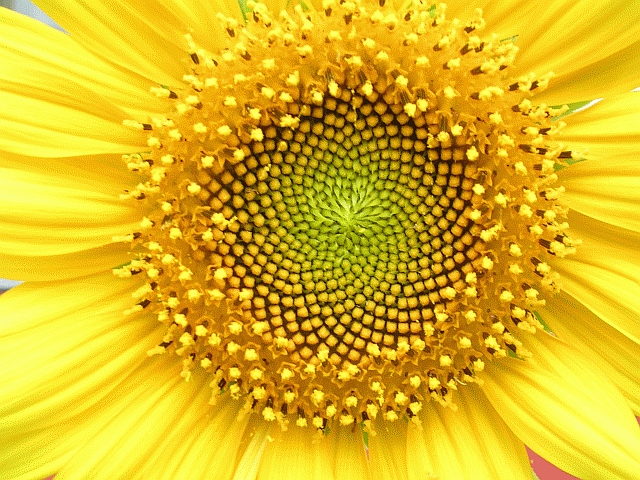
Why? People often say the plant "grows by adding up the last two stages". That is not the real reason. Here is what actually happens.
What the growing tip does
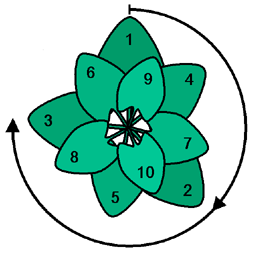
A sunflower head grows outwards from a tiny tip at its very centre. The tip makes new buds one at a time, and each bud later becomes a seed. Each new bud appears in the spot around the tip where there is the most room, as far as possible from the buds made just before it. Then it slowly gets pushed outwards as newer buds form behind it.
Experiments show that, because of this, each new bud ends up turned round by the same angle from the one before. The question is: which angle?
Why most angles waste space
Suppose the angle were exactly a quarter turn, 90°.
- Bud 1 points north.
- Bud 2 points east.
- Bud 3 points south.
- Bud 4 points west.
- Bud 5 points north again, right behind bud 1.
Every fifth bud lines up with an earlier one. All the seeds end up in four straight lines, like the spokes of a wheel, with big empty wedges between them. That wastes a lot of space.
The same happens for any angle that is a simple fraction of a turn. A third of a turn gives three spokes. Two fifths of a turn gives five spokes.
Even an angle that is just close to a simple fraction causes trouble. The seeds form spokes that drift slowly, leaving gaps. To fill the head evenly, the plant needs a fraction of a turn that is as far as possible from every simple fraction. From section 4, that is the golden ratio.
The golden angle
The turn that the plant actually ends up using is about 0.382 of a full turn. That number is \frac{1}{\varphi^2}, since \varphi^2 = 2.618 and 1 \div 2.618 = 0.382. In degrees:
360° \times 0.381966\ldots = 137.5°
This is called the golden angle. Turning 137.5° one way is the same as turning 360° - 137.5° = 222.5° the other way. And 222.5 \div 137.5 = 1.618, which is \varphi. So the golden angle cuts the full circle into two parts in the golden ratio.

The model in the picture was published by H. Vogel in 1979. Here is the whole recipe:
- Put seed number n at an angle of n \times 137.5° round from the start.
- Put it at a distance from the centre equal to \sqrt n (times some fixed spacing).
The square root keeps the seeds equally crowded as the disc grows. The area inside a circle grows with its radius squared. So if the radius is \sqrt n, the area inside it grows in step with n, the number of seeds. Nothing else is put into the recipe. Yet the crossing spirals appear by themselves, and when you count them, they come out as Fibonacci numbers.
Why the spiral counts are Fibonacci numbers
The spirals your eye sees are lines of seeds that happen to sit close to each other. When does seed number n sit close to seed number n + k? When k turns of 0.382 add up to almost a whole number of full turns. Then the two seeds point in almost the same direction.
Try some values of k. The exact turn is 0.381966 of a circle.
| k | k × 0.381966 turns | Nearest whole number | How far off |
|---|---|---|---|
| 4 | 1.528 | 2 | 0.47, far |
| 6 | 2.292 | 2 | 0.29, far |
| 7 | 2.674 | 3 | 0.33, far |
| 8 | 3.056 | 3 | 0.06, close |
| 13 | 4.966 | 5 | 0.03, closer |
| 21 | 8.021 | 8 | 0.02, very close |
The values of k that line seeds up are 8, 13, 21, and so on: Fibonacci numbers. The others, like 4, 6 and 7, leave seeds pointing in quite different directions. That is because, from section 4, the best fractions for the golden ratio are the Fibonacci ratios. So the seeds that line up are a Fibonacci number apart, and the number of spirals in each family is a Fibonacci number.
Proof without a plant
In 1992, two French physicists, Stéphane Douady and Yves Couder, showed this with no plant at all. They dripped tiny drops of a magnetic liquid, one at a time, into the centre of a dish. The drops pushed each other apart and drifted outwards, just like buds. At the right dripping speed, each new drop settled at about 137.5° from the last, and Fibonacci spirals appeared. The golden angle is not something the plant "knows". It is what you get when each new thing appears wherever there is the most room.
The same angle shows up in the scales of pine cones and pineapples, and in the way leaves are spaced around many stems. Each new leaf grows about 137.5° round from the one below it. That way, no leaf sits directly above another, and the leaves shade each other as little as possible.
6. What is not true about it
The golden ratio attracts more false claims than any other number. Here are the common ones, and what the evidence actually says.
"The Parthenon is built on the golden ratio." The Parthenon is an ancient temple in Athens, built around 440 BCE. You can draw golden rectangles on a photo of its front, but only by choosing which edges to measure. Different choices give different ratios. There is no record that its builders used the golden ratio at all.
"Leonardo used it in the Mona Lisa." Leonardo da Vinci did draw the pictures for a 1509 book about this ratio, De divina proportione, by his friend Luca Pacioli. But no drawing or note of Leonardo's shows him using it to plan a painting. The rectangles people draw on the Mona Lisa are added afterwards.
"The nautilus shell is a golden spiral." The nautilus is a sea creature with a beautiful spiral shell. Each turn of its spiral is usually about 1.3 times wider than the last, not 1.618 times. It is a lovely spiral, but not a golden one.
"Your body and face are built on it." Pick enough pairs of body measurements and some will come out near 1.6 just by chance. Human bodies vary far too much for any one ratio to describe them.
"People find golden rectangles the most beautiful." The German psychologist Gustav Fechner tested this in 1876 and found a mild preference. Later experiments gave mixed results. People's choices depend strongly on how the question is asked.
"A credit card is a golden rectangle." A standard bank card is 85.6 mm by 53.98 mm. Divide: 85.6 \div 53.98 = 1.586. That is close to 1.618, but it was not designed from it.
None of this makes the number less interesting. The pentagon, the Fibonacci numbers and the sunflower are all real. Their true explanations are better than any of the myths.
7. Where φ shows up in your life
Every sunflower, pineapple, pine cone and cauliflower. Count the spirals next time. They will almost always be neighbouring Fibonacci numbers: often 8 and 13 on a pine cone or a pineapple, and 34 and 55 on a big sunflower.
A quick way to turn miles into kilometres. One mile is 1.609 km. That happens to be very close to \varphi. It is pure coincidence, because the mile and the kilometre were defined separately. But it means that the next Fibonacci number is a good conversion: 5 miles is about 8 km, 8 miles is about 13 km, and 13 miles is about 21 km.
Every star you draw. A five-pointed star is a pentagram. Every length in it is \varphi times the next. If you have ever drawn a star, you have drawn the golden ratio.
A new kind of solid. For centuries, scientists believed the atoms in a solid crystal could only repeat in patterns of squares, triangles or hexagons, like floor tiles. Never in fives, because regular pentagons cannot tile a floor without gaps. Then in 1982 the Israeli scientist Dan Shechtman found a metal with five-fold patterns in its atoms. A material like this is called a quasicrystal. Its pattern is perfectly ordered, but it never exactly repeats. The spacings in its pattern are set by \varphi. Many scientists refused to believe him at first. He received the Nobel Prize in Chemistry in 2011.
We have now met the five most famous numbers. Each has a family of lesser-known cousins, and one of them holds a famous unsolved question in mathematics. Next: 11.11 — The Rest of the Cast.