Appearance
11.7 — π: The Number of a Full Turn
Take a dinner plate and a piece of string. Wrap the string once around the edge of the plate, and mark where it meets itself. Now lay that same string straight across the plate, through the middle, from edge to edge.
You will find that the string goes across a little more than three times, with a small piece left over.
Now do the same with a coin, or a bicycle wheel, or a round pond. The answer is always the same: a little more than three times. That "little more than three" is the number we call π. This page is its story.
1. What π is, and why it is the same for every circle
Three words first
- The circumference of a circle is the distance all the way round its edge. That is the length of the string you wrapped round the plate.
- The diameter is the distance straight across, through the centre. That is the string laid across.
- The radius is the distance from the centre to the edge. It is half of the diameter.
The definition
π is the circumference divided by the diameter:
\pi = \frac{\text{circumference}}{\text{diameter}} \approx 3.14159
The symbol π is the Greek letter "pi", read like the English word "pie". The squiggle \approx means "is approximately equal to". We cannot write π exactly with digits, because its decimals go on forever, as we will see.
You can turn the definition around. If you know the diameter, multiply by π to get the circumference. Since the diameter is two radii, the circumference is also 2 \times \pi \times \text{radius}, which people write as 2\pi r, where r stands for the radius.
Why every circle gives the same answer
This is not obvious, so let us think about it. Why should a tiny coin and a huge pond give exactly the same ratio?
The reason is that all circles have the same shape. A small circle is just a big circle shrunk down, like a photo made smaller. When you shrink a photo to half its size, every length in it becomes half as long. The width halves. The height halves. Every distance halves.
So when you shrink a circle to half its size, the circumference halves, and the diameter halves too. Now divide one by the other. Half divided by half is the same as the original division. The shrinking cancels out.
That is true for any amount of shrinking or stretching. So the ratio cannot depend on the size of the circle at all. It is one fixed number for every circle in the universe.
The same number gives the area
The area of a shape is how much flat space it covers. Here is a remarkable fact: the same π controls the area of a circle.
\text{area} = \pi \times r \times r = \pi r^2
Here r^2, read "r squared", means r times r. Here is why this is true. Chapter 3.3 has a picture of it.
- Cut the circle into many thin slices, like slices of a pizza.
- Lay the slices in a row, pointing alternately up and down, so that they fit together like the teeth of a zip.
- The row looks almost like a rectangle. The more slices you cut, the more it looks like a perfect rectangle.
- The height of that rectangle is the length of one slice, which is the radius r.
- The width of the rectangle is made of the curved crusts of the slices. Half of the slices point up and half point down, so the crusts along the bottom are half of all the crust. All the crust together is the circumference, 2\pi r. Half of it is \pi r.
- The area of a rectangle is width times height: \pi r \times r = \pi r^2.
So one number links the length around a circle and the space inside it.
The name
The letter π was first used for this number by the Welsh mathematician William Jones in 1706. He took it from the first letter of the Greek word periphereia, meaning "the line around". Our English word "periphery" comes from the same root. The great Swiss mathematician Leonhard Euler started using it in the 1730s. Everyone read Euler, so everyone followed.
2. The first values people used
Long before anyone could work out π accurately, people needed it to measure land and to build. Here is how a few of them did it.
Egypt: a field turned into a square
Around 1550 BCE, an Egyptian scribe named Ahmes copied out a long scroll of mathematics. It was written on papyrus, a kind of paper made from reeds. It is now in the British Museum in London and is called the Rhind papyrus, after the man who bought it in 1858.

The papyrus is like a school exercise book. It contains 84 exercises, each with its answer. Modern scholars have numbered them 1 to 84 so they can refer to them. Exercise number 50 is about a round field that is 9 khet across. A khet was an Egyptian unit of length, about 52 metres. The exercise asks: what is the area of this field?
Ahmes did not know about π. So he used a clever shortcut. He replaced the round field with a square field that has nearly the same area. Here is his rule, written as steps.
- Take the width of the round field: 9.
- Take away one ninth of it. One ninth of 9 is 9 \div 9 = 1. So 9 - 1 = 8.
- Make a square whose sides are each 8. Its area is 8 \times 8 = 64.
- Say that the round field has the same area as this square: 64.
Why does this make sense? A square with sides as long as the field's width would be too big, because it pokes out beyond the circle at the corners. Shrinking the side a little, by one ninth, makes the square's area close to the circle's. Ahmes, or the teachers before him, had found by experience that one ninth was about right.
How good was it? Now that we know the area formula from section 1, we can check. The field is 9 across, so its radius is half of that, 4.5. The true area is:
\pi \times 4.5 \times 4.5 = \pi \times 20.25 \approx 63.6
Ahmes said 64. That is wrong by less than 1%. It is good enough to tax a field fairly.
We can also ask what value of π his rule secretly uses. His rule says the area is 64. The formula says it is \pi \times 20.25. If both were true:
\pi \times 20.25 = 64, \qquad\text{so}\qquad \pi = \frac{64}{20.25} \approx 3.1605
So the Egyptian rule behaves as if π were 3.1605. The true value is 3.14159.
Babylon: a hexagon inside a circle
Babylonian scribes around 1900–1600 BCE used 3\frac18. That is read "three and one eighth", which means 3 + \frac18 = 3.125.
They got it by drawing a hexagon, a shape with six equal straight sides, inside a circle so that its corners touch the circle. Each side of such a hexagon is exactly as long as the circle's radius (section 3 explains why). So the hexagon's six sides add up to 6 radii, which is 3 diameters. A tablet found at Susa, in modern Iran, says the hexagon's edge is \frac{24}{25} of the circle's edge. That makes the circle's edge 3 \div \frac{24}{25} = 3 \times \frac{25}{24} = 3.125 diameters.
The Bible
1 Kings 7:23, written around 600 BCE, describes a great bronze basin. It says the basin was "ten cubits from brim to brim" and "a line of thirty cubits did compass it round about". A cubit was the length of a forearm. So the basin was 10 across and 30 round, which makes π equal to 30 \div 10 = 3. The verse is describing an object, not teaching mathematics, so a rounded number is no surprise.
India: Aryabhata
The Indian astronomer Aryabhata wrote this rule in 499 CE. It reads: "Add 4 to 100, multiply by 8, and add 62,000. This is the approximate circumference of a circle whose diameter is 20,000."
Follow it: 100 + 4 = 104. Then 104 \times 8 = 832. Then 832 + 62000 = 62832. So a circle 20,000 across is 62,832 round. Divide: 62832 \div 20000 = 3.1416. That is correct to four decimal places.
He used the Sanskrit word āsanna, which means "approaching". Some historians think that word shows he knew the true value could only be approached, never written exactly.
The values side by side
| Who | When | Value | As a decimal |
|---|---|---|---|
| Babylonian scribes | about 1900–1600 BCE | 3\frac18 | 3.125 |
| Ahmes, Egypt | about 1550 BCE | \frac{64}{20.25} | 3.1605 |
| The Bible | about 600 BCE | 3 | 3 |
| Archimedes, Greece | about 250 BCE | between 3\frac{10}{71} and 3\frac17 | 3.1408 to 3.1429 |
| Aryabhata, India | 499 CE | \frac{62832}{20000} | 3.1416 |
Archimedes' row is different from all the others. The other rows are values that people used. Archimedes proved that π had to lie between his two numbers. He could not say exactly what it was, but he trapped it in a narrow gap and showed it could not escape. The next section shows how.
3. Archimedes traps π between two shapes
The idea
A polygon is a flat shape with straight sides, like a triangle, a square or a hexagon. A regular polygon has all its sides the same length and all its corners the same angle.
The trouble with a circle is that its edge is curved. Nobody can lay a straight ruler along a curve to measure it. But the edge of a polygon is made of straight pieces, and straight pieces are easy to measure.
So Archimedes had an idea that fits in one sentence. Draw a polygon just inside the circle and another just outside it. The circle's edge is longer than the inside polygon's edge and shorter than the outside polygon's edge. So π is squeezed between two numbers you can work out.
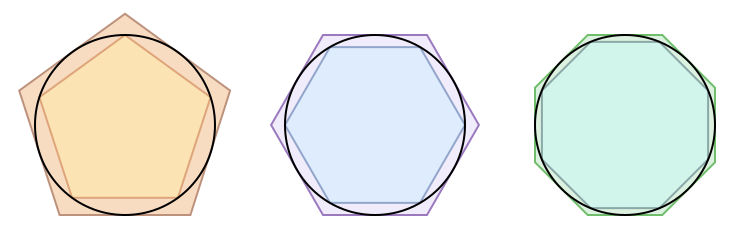
Then he doubled the number of sides, and doubled again, and again. More sides means the polygons hug the circle more closely. So each doubling makes the squeeze tighter.
To make the arithmetic simple, take a circle with radius 1. Then its diameter is 2. Its circumference is π times the diameter, which is 2\pi.
Suppose the inside polygon has n sides, each of length s. Its edge is n \times s long. That is shorter than the circle's edge, 2\pi. So n \times s < 2\pi. The sign < means "is less than". Divide both sides by 2:
\pi > \frac{n \times s}{2}
The sign > means "is greater than". So any inside polygon gives a number that π must be bigger than.
Step 1: the hexagon
Start with six sides. Draw a regular hexagon inside the circle with its corners on the circle. Draw a line from the centre of the circle to each corner. That cuts the hexagon into six triangles, like six slices of a cake.
Look at one triangle.
- Two of its sides go from the centre to the edge of the circle. So both are radii, of length 1.
- The angle at the centre is a sixth of a full turn. A full turn is 360°, so the angle is 360° \div 6 = 60°.
- The angles of any triangle add up to 180°. The two angles at the edge are equal, because the two sides beside them are equal. So they share 180° - 60° = 120°, and each is 60°.
- All three angles are 60°. A triangle with all angles equal has all sides equal. So the third side, which is a side of the hexagon, is also 1.
So each side of the hexagon is 1. With n = 6 and s = 1:
\pi > \frac{6 \times 1}{2} = 3
That is the first proved fact: π is bigger than 3.
Step 2: going from 6 sides to 12
Now we need a way to double the number of sides. Look at the picture below. It shows one side of the inside polygon. A straight line joining two points on a circle is called a chord, so we will call this side the old chord, with length s.
Here is what is in the picture.
- O is the centre of the circle.
- A and B are two corners of the polygon, on the circle. The straight line AB is one side, of length s.
- M is the exact middle of AB. So AM is half a side: \frac{s}{2}.
- The line from O to M meets AB at a right angle, a perfect square corner like the corner of a page. The little square at M marks it. Call the length OM by the letter h.
- Carry that line on past M until it hits the circle. That point is P. It sits exactly halfway round the curve from A to B.
- The new side is AP. Two of these, AP and PB, replace the single old side AB. So the polygon now has twice as many sides. We call the new length s', read "s prime". It just means "the new s".
We want to find s' from s. The only tool we need is Pythagoras' theorem (Chapter 3.2). It says: in a triangle with a right angle, the long side squared equals the two short sides squared and added.
Part 1. Find h. Look at the triangle O, M, A. It has a right angle at M. Its long side is OA, a radius, so OA = 1. Its short sides are OM = h and AM = \frac{s}{2}. By Pythagoras:
h^2 + \left(\frac{s}{2}\right)^2 = 1^2
Since \left(\frac{s}{2}\right)^2 = \frac{s}{2} \times \frac{s}{2} = \frac{s^2}{4}, and 1^2 = 1, this says h^2 + \frac{s^2}{4} = 1. Take \frac{s^2}{4} away from both sides:
h^2 = 1 - \frac{s^2}{4}
Part 2. Find MP. The whole line from O to P is a radius, so it is 1 long. The part from O to M is h. So the rest, from M to P, is 1 - h.
Part 3. Find the new side. Look at the triangle A, M, P. It also has a right angle at M. Its short sides are AM = \frac{s}{2} and MP = 1 - h. Its long side is the new side AP = s'. By Pythagoras again:
s'^2 = \left(\frac{s}{2}\right)^2 + (1 - h)^2
Part 4. Tidy it up. The first piece is \frac{s^2}{4}, as before. For the second piece, multiply out (1 - h) \times (1 - h), each part by each part:
(1 - h)(1 - h) = 1 - h - h + h^2 = 1 - 2h + h^2
So:
s'^2 = \frac{s^2}{4} + 1 - 2h + h^2
Now use Part 1 to replace h^2 with 1 - \frac{s^2}{4}:
s'^2 = \frac{s^2}{4} + 1 - 2h + 1 - \frac{s^2}{4}
The \frac{s^2}{4} at the start and the -\frac{s^2}{4} at the end cancel each other out. The two 1s add to 2. What is left is:
s'^2 = 2 - 2h
Part 5. Get rid of h. From Part 1, h is the square root of 1 - \frac{s^2}{4}. So 2h = 2\sqrt{1 - \frac{s^2}{4}}. We can move the 2 inside the square root, because 2 = \sqrt4, and two square roots multiplied together are the square root of the product:
2h = \sqrt{4} \times \sqrt{1 - \frac{s^2}{4}} = \sqrt{4 - s^2}
So the doubling rule is:
s'^2 = 2 - \sqrt{4 - s^2}
Read it aloud: "the new side squared equals two, minus the square root of four minus the old side squared". Give it the old side, and it gives you the new side.
Step 3: the outside polygon
For the other side of the squeeze, we need a polygon outside the circle, whose sides just touch it. Its sides are a little longer than the inside polygon's.
Look at the picture again. The inside side AB sits at distance h from the centre O. An outside side would sit at distance 1 from O, touching the circle at P. It is the same shape, just pushed outwards and stretched. Stretching a shape so that one distance goes from h to 1 multiplies every length by \frac{1}{h}. So the outside side has length \frac{s}{h}.
The outside polygon's edge is longer than the circle's. So, by the same reasoning as before:
\pi < \frac{n}{2} \times \frac{s}{h}
Step 4: run the rule four times
Let us do the first doubling with every step shown.
From 6 sides to 12. The hexagon's side is s = 1, so s^2 = 1.
- New side squared: 2 - \sqrt{4 - 1} = 2 - \sqrt{3}. Since \sqrt3 \approx 1.732051, this is 2 - 1.732051 = 0.267949.
- New side: s = \sqrt{0.267949} = 0.517638.
- Lower limit: \frac{12 \times 0.517638}{2} = 3.10583.
- For the upper limit we need h for this new polygon: h = \sqrt{1 - \frac{0.267949}{4}} = \sqrt{0.933013} = 0.965926. Upper limit: \frac{12}{2} \times \frac{0.517638}{0.965926} = 3.21539.
So π is between 3.10583 and 3.21539. Each further row uses the row before in exactly the same way.
| Sides | Side squared | Side | π is more than | π is less than |
|---|---|---|---|---|
| 6 | 1 | 1 | 3.00000 | 3.46410 |
| 12 | 0.267949 | 0.517638 | 3.10583 | 3.21539 |
| 24 | 0.068148 | 0.261052 | 3.13263 | 3.15966 |
| 48 | 0.017110 | 0.130806 | 3.13935 | 3.14609 |
| 96 | 0.004282 | 0.065438 | 3.14103 | 3.14271 |
Watch the last two columns close in on each other. At 96 sides, π is trapped between 3.14103 and 3.14271.
Archimedes had no decimals. He worked with fractions, and he had to round every square root by hand. Each time, he rounded in the safe direction, so that his limits were sure to be true. He wrote his answer like this:
3\tfrac{10}{71} < \pi < 3\tfrac{1}{7}
Read it as "three and ten seventy-firsts is less than π, which is less than three and one seventh". As decimals, that is 3.1408 < \pi < 3.1429. The upper limit, 3\frac17, is the same as \frac{22}{7}. That is the value many of us learned at school, and it came from here.
Look at what Archimedes did. He could not measure a curve. So he trapped it between straight shapes he could measure, and let them close in. That is the central idea of calculus, about 1,900 years before calculus was invented. Chapter 5.1 calls it a limit: a value you can get as close to as you like by taking more and more steps.
Others who carried on
- Liu Hui, in China in 263 CE, used the same idea and went up to a polygon with 3,072 sides. He got 3.1416.
- Zu Chongzhi, in China around 480 CE, proved that π is between 3.1415926 and 3.1415927. No one in the world had a more accurate value for about 900 years.
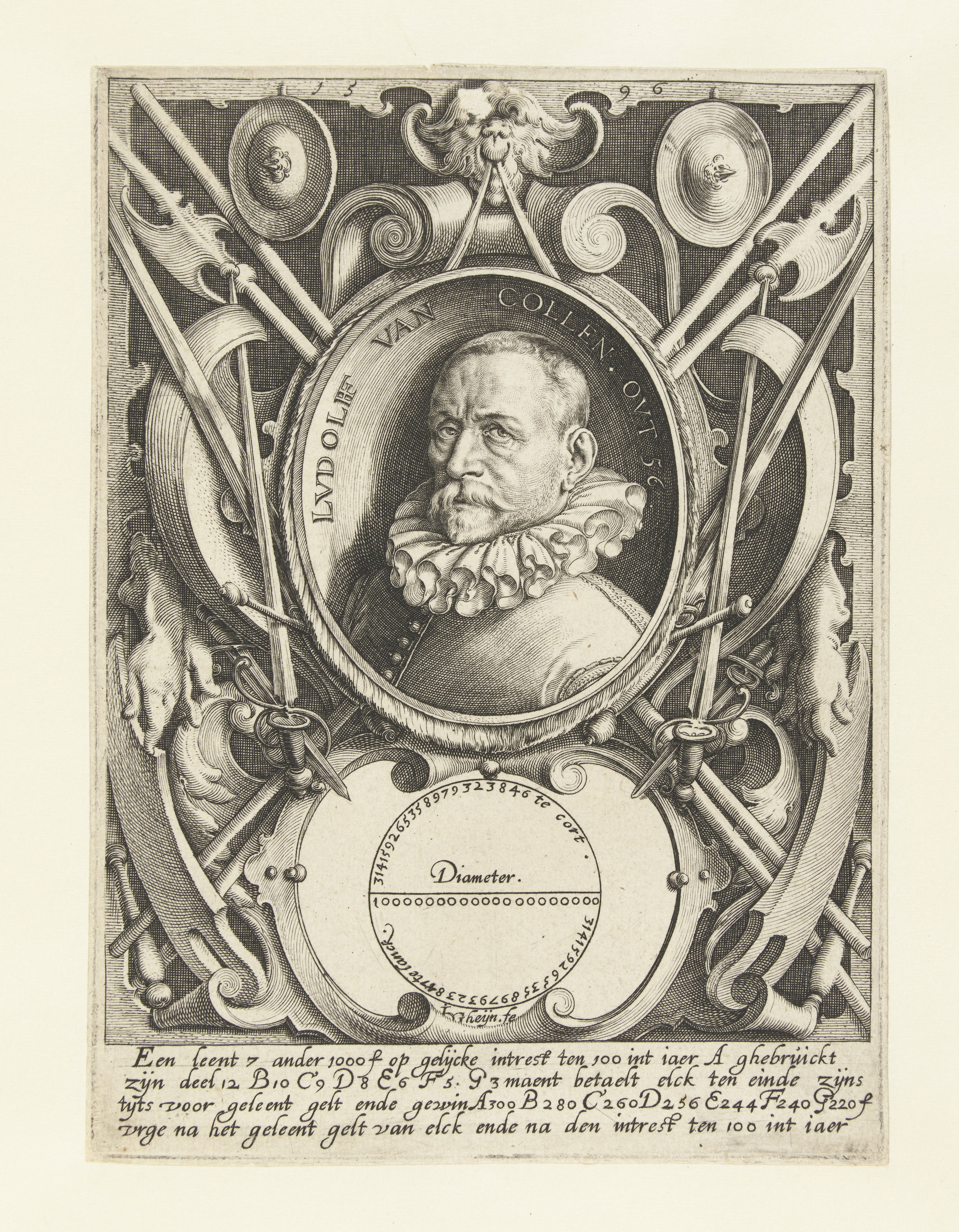
- Ludolph van Ceulen, a fencing teacher and mathematician in the Netherlands, spent much of his life on it. By the time he died in 1610 he had 35 decimal places, using polygons with more than four billion billion sides. The digits were carved on his gravestone. Germans called π "the Ludolphine number" for a long time afterwards.
Why Zu Chongzhi's fraction 355/113 is so good
Zu also gave the fraction \frac{355}{113}. It equals 3.1415929..., correct to six decimal places. That is astonishing for a fraction with such small numbers. Here is the reason.
Chapter 11.6 built a "tower" of fractions for \sqrt2. You build one for any number like this: write down the whole-number part, flip what is left over, and repeat. Do it for π.
- π = 3.14159... The whole part is 3. Left over: 0.14159.
- Flip the leftover: 1 \div 0.14159 = 7.0625. The whole part is 7. Left over: 0.0625.
- Flip again: 1 \div 0.0625 = 15.997. The whole part is 15. Left over: 0.997.
- Flip again: 1 \div 0.997 = 1.0034. The whole part is 1. Left over: 0.0034.
- Flip again: 1 \div 0.0034 = 292.6. The whole part is 292.
So the tower for π has 3, 7, 15, 1, 292, and so on, on its floors.
Now notice step 5. The leftover at step 4 was tiny, only 0.0034. That tiny leftover is why the next number is so big, 292. A tiny leftover means that stopping just before it loses almost nothing. Stop the tower after the 1, and work out the fraction it gives. You get \frac{355}{113}. Because the piece you threw away was so small, the fraction is far more accurate than its size suggests.
4. π from adding fractions
Polygons are slow. Each doubling needs a harder square root. The next great step came from a completely different idea: an endless list of simple fractions that adds up to π.
\frac{\pi}{4} = 1 - \frac13 + \frac15 - \frac17 + \frac19 - \cdots
Read it aloud: "π over four equals one, minus a third, plus a fifth, minus a seventh, plus a ninth, and so on forever". The bottom numbers are the odd numbers. The signs take turns, minus then plus. The three dots mean "carry on in the same pattern forever".
This was first found in Kerala, in south India, by Madhava of Sangamagrama, who lived from about 1340 to 1425. His students wrote it down, and a book called the Yuktibhāṣā, written around 1530, records his proof. In Europe, James Gregory found it in 1671 and Gottfried Leibniz in 1674, without knowing about Kerala. It is often called the Madhava–Leibniz series. A series just means a sum with endlessly many terms.
Where the sum comes from
The proof needs four tools. Each one is explained here before it is used. Chapter 5 teaches them in full.
Tool 1: the tangent of an angle, and its reverse. Picture a ramp. It goes up a certain height while going along a certain distance. The tangent of the ramp's angle is the height divided by the distance along (Chapter 3.5). A ramp that goes up 1 metre for every 1 metre along has a tangent of 1 \div 1 = 1. Its angle is 45°, exactly halfway between flat and straight up.
The arctangent asks the reverse question: "which angle has this tangent?" We write it \arctan. So \arctan 1 asks "which angle has a tangent of 1?", and the answer is 45°.
Mathematicians usually measure angles in radians instead of degrees (Chapter 3.3). A radian measures an angle by how far you walk round a circle of radius 1. In radians, a full turn is 2\pi. So 45°, which is one eighth of a full turn, is \frac{2\pi}{8} = \frac{\pi}{4} radians. So:
\arctan 1 = \frac{\pi}{4}
That is where the \frac{\pi}{4} in our sum comes from.
Tool 2: how fast the arctangent changes. The derivative of something tells you how fast it changes (Chapter 5.2). For example, if you are driving, your speed is the derivative of your distance. Chapter 5.3 works out how fast the arctangent changes. The rate is:
\text{rate of change of } \arctan x = \frac{1}{1 + x^2}
You can check it with real numbers. Near x = 1, the formula says the rate should be \frac{1}{1 + 1} = \frac12. That means: increase x a tiny bit, and the angle increases by half as much. The tangent of 45° is 1, and the tangent of 46° is 1.0355. So increasing the angle by 1°, which is 0.01745 radians, increased x by 0.0355. The angle grew by 0.01745 while x grew by 0.0355. And 0.01745 \div 0.0355 \approx 0.49, which is very close to one half. The formula works.
Tool 3: turning a fraction into an endless sum. Here is a fact about sums that keep shrinking. Take 1 + \frac12 + \frac14 + \frac18 + \cdots, where each term is half the one before. Walk half way across a room, then half of what is left, then half of that. You get closer and closer to the far wall, which is exactly 2 halves away. So the sum is 2. In the same way, the following holds for any number r between -1 and 1, as we prove in Chapter 5.8:
1 + r + r^2 + r^3 + \cdots = \frac{1}{1 - r}
With r = \frac12, the right side is \frac{1}{1/2} = 2, which matches the walk. Now put r = -x^2. Then r^2 = x^4, r^3 = -x^6, and so on, and 1 - r = 1 + x^2. So:
\frac{1}{1 + x^2} = 1 - x^2 + x^4 - x^6 + \cdots
Tool 4: adding up the changes. If you know how fast something changes at every moment, you can add up all the little changes to find the total. If you know your speed at every moment of a journey, you can work out how far you went. This adding up is called integration (Chapter 5.5).
For powers there is a simple rule. Something that changes at rate x^k adds up to \frac{x^{k+1}}{k+1}. Check it with k = 1: the rule says rate x adds up to \frac{x^2}{2}. Is the rate of change of \frac{x^2}{2} really x? At x = 3, \frac{x^2}{2} = 4.5. At x = 3.001, it is 4.5030005. The increase is 0.0030005 for a step of 0.001, a rate of 3.0005. That is x = 3, as the rule says.
Now put the four tools together.
- Tool 2 says the arctangent changes at rate \frac{1}{1 + x^2}.
- Tool 3 says that rate is 1 - x^2 + x^4 - x^6 + \cdots
- Tool 4 adds up each piece from 0 to x. Rate 1 adds up to x. Rate x^2 adds up to \frac{x^3}{3}. Rate x^4 adds up to \frac{x^5}{5}. And so on.
- The arctangent starts at 0 when x = 0. So adding up all the changes gives the arctangent itself:
\arctan x = x - \frac{x^3}{3} + \frac{x^5}{5} - \frac{x^7}{7} + \cdots
- Finally, put x = 1. Every power of 1 is just 1. And by Tool 1, the left side is \frac{\pi}{4}. That gives Madhava's series.
One honest note. Tool 3 needs r to be strictly between -1 and 1, and at exactly x = 1 we are right on the edge. The result is still true there, but proving that last step needs a careful argument about limits, which Chapter 5.8 discusses.
It works, but slowly
Here is what you get when you add the terms one by one and multiply by 4:
| Terms added | 4 × the sum |
|---|---|
| 1 | 4.00000 |
| 2 | 2.66667 |
| 3 | 3.46667 |
| 10 | 3.04184 |
| 100 | 3.13159 |
| 1,000 | 3.14059 |
After a thousand terms, only three digits are right. The total keeps jumping above π and then below it, closing in very slowly. Madhava knew this. He found clever corrections that gave him 11 correct digits.
Machin's shortcut
Why is it so slow? Because at x = 1, every power is still 1. So the terms shrink only as fast as \frac13, \frac15, \frac17, \frac19 do, which is very slowly.
If instead we put a small number into the arctangent series, the powers shrink very fast. With x = \frac15: the first term is \frac15 = 0.2. The next uses \left(\frac15\right)^3 = \frac{1}{125}. The next uses \left(\frac15\right)^5 = \frac{1}{3125}. Each term is 25 times smaller than the one before.
In 1706 the English astronomer John Machin found a way to make π out of arctangents of small numbers:
\frac{\pi}{4} = 4\arctan\frac15 - \arctan\frac{1}{239}
This looks like magic, but it comes from one rule in Chapter 3.5. That rule tells you the tangent of two angles added together:
\tan(A + B) = \frac{\tan A + \tan B}{1 - \tan A \times \tan B}
Let us call a the angle whose tangent is \frac15. Now use the rule to double it, with both A and B equal to a:
\tan 2a = \frac{\frac15 + \frac15}{1 - \frac15 \times \frac15} = \frac{\frac25}{1 - \frac{1}{25}} = \frac{\frac25}{\frac{24}{25}}
To divide by \frac{24}{25}, flip it and multiply: \frac25 \times \frac{25}{24} = \frac{50}{120} = \frac{5}{12}. So \tan 2a = \frac{5}{12}.
Double again, using the rule with both angles equal to 2a:
\tan 4a = \frac{\frac{5}{12} + \frac{5}{12}}{1 - \frac{5}{12} \times \frac{5}{12}} = \frac{\frac{10}{12}}{1 - \frac{25}{144}} = \frac{\frac{10}{12}}{\frac{119}{144}}
Flip and multiply: \frac{10}{12} \times \frac{144}{119} = \frac{1440}{1428} = \frac{120}{119}. So \tan 4a = \frac{120}{119}.
Now \frac{120}{119} is just a tiny bit more than 1. The angle with tangent exactly 1 is 45°, which is \frac{\pi}{4}. So 4a is just a tiny bit more than \frac{\pi}{4}. How much more? The same chapter has the rule for subtracting angles:
\tan(A - B) = \frac{\tan A - \tan B}{1 + \tan A \times \tan B}
Use it with A = 4a (tangent \frac{120}{119}) and B = \frac{\pi}{4} (tangent 1):
\tan\left(4a - \frac{\pi}{4}\right) = \frac{\frac{120}{119} - 1}{1 + \frac{120}{119}} = \frac{\frac{1}{119}}{\frac{239}{119}} = \frac{1}{239}
The top is \frac{120 - 119}{119} = \frac{1}{119}. The bottom is \frac{119 + 120}{119} = \frac{239}{119}. Dividing, the 119s cancel and leave \frac{1}{239}.
So the leftover angle 4a - \frac{\pi}{4} is the angle whose tangent is \frac{1}{239}. Move things around, and you get Machin's formula.
Why it is so fast. Both arctangents now use small numbers. With just four terms of the series for \frac15 and one term for \frac{1}{239}, you already get π = 3.1415917, which is six correct digits. Madhava's series needed a thousand terms to get three. Machin used his formula to work out 100 digits by hand. Formulas like his held the records for 250 years.
Today's records
Modern computers use series in the style of Ramanujan (Chapter 11.3), where each term adds about 14 more correct digits. π is now known to hundreds of trillions of digits. That is a test of computers, not something science needs. NASA's Jet Propulsion Laboratory uses only 15 decimal places to steer spacecraft across the solar system. About 40 decimal places would let you work out the distance around the whole visible universe to within the width of a single atom.
5. π from dropping needles
Here is a way to find π that seems to have nothing to do with circles. In 1733 the French scientist Georges-Louis Leclerc, Comte de Buffon, asked a question about chance.
Draw straight lines on the floor, all parallel, all the same distance apart. Call that distance d. Drop a needle of length \ell (the letter "ell") onto the floor at random. Make the needle no longer than the gap between lines. What is the chance that the needle lands across one of the lines?

The answer is:
\text{chance of crossing} = \frac{2\ell}{\pi d}
Read it aloud: "two ell divided by π dee". Suppose the needle is exactly as long as the gap, so \ell = d. Then the chance is \frac{2}{\pi} \approx 0.6366. About 64 needles out of every 100 will cross a line. So if you drop thousands of needles and count, you can work out π.
Where the π comes from
What describes one drop. Every drop can be described by two numbers.
- The first is how far the middle of the needle lands from the nearest line. Call it x. It can be anything from 0 (right on a line) up to half the gap, \frac{d}{2} (exactly between two lines). Every value is equally likely.
- The second is the angle the needle makes with the lines. Call it \theta, the Greek letter "theta". It can be anything from 0 (lying along the lines) up to a right angle, which is \frac{\pi}{2} radians (pointing straight across). Every angle is equally likely.
When does it cross? Half of the needle sticks out on each side of its middle. Each half is \frac{\ell}{2} long. When the needle is tilted at angle \theta, each half reaches across a distance of \frac{\ell}{2} \times \sin\theta towards the lines. (The sine of an angle tells you what fraction of a tilted length points straight across; Chapter 3.5.) So the needle crosses a line exactly when its middle is closer to the line than that reach:
x \le \frac{\ell}{2}\sin\theta
The sign \le means "is less than or equal to".
Picture all the drops at once. Draw a rectangle. Let the distance across stand for the angle \theta, from 0 to \frac{\pi}{2}. Let the height stand for the middle's distance x, from 0 to \frac{d}{2}. Every possible drop is one point in this rectangle, and every point is equally likely. The rectangle's area is:
\frac{\pi}{2} \times \frac{d}{2} = \frac{\pi d}{4}
Now draw the curve x = \frac{\ell}{2}\sin\theta inside the rectangle. The drops that cross are the points under that curve. So the chance of crossing is the area under the curve divided by the area of the whole rectangle.
The area under the curve. The area under one hump of the sine curve, from 0 to a right angle, is exactly 1 (Chapter 5.5 works it out). You can check this by cutting the area into thin upright strips and adding them up. With ten strips, you get 1.001. With more strips, you get even closer to 1. Our curve is the sine curve made \frac{\ell}{2} times taller, so its area is \frac{\ell}{2} \times 1 = \frac{\ell}{2}.
The chance.
\text{chance} = \frac{\ell / 2}{\pi d / 4}
To divide by \frac{\pi d}{4}, flip and multiply: \frac{\ell}{2} \times \frac{4}{\pi d} = \frac{4\ell}{2\pi d} = \frac{2\ell}{\pi d}.
So where is the circle? It is in the angle. A needle can land pointing in any direction at all. All the directions you can point in, from one spot, make a circle around that spot. The π measures that spread of directions. Whenever something can point any way round, a circle is hiding there, and π comes with it.
A warning about too-good results
In 1901 an Italian mathematician, Mario Lazzarini, said he had dropped a needle 3,408 times and got π as 3.1415929. That is exactly \frac{355}{113}, correct to six places. It is far too good. With only a few thousand drops, ordinary luck should spoil the third or fourth digit. It turns out that 3,408 is exactly the number of drops that can make \frac{355}{113} come out. Most people now think he stopped dropping at the moment the answer looked best. The lesson is that a result can be true while the experiment behind it is dishonest.
6. Why π turns up where there is no circle
Here is the deepest question about π. It appears in the sum 1 + \frac14 + \frac19 + \frac{1}{16} + \cdots. It appears in the bell curve of exam marks. It appears in the swing of a pendulum, and in the law of electric force. None of those questions mentions a circle.
The answer, every time, is that a circle is there, but hidden. It hides in one of three ways.
Hiding place 1: something that repeats
A full turn is 2\pi radians. So anything that goes round and comes back to where it started carries π with it.
Here is the key fact, from Chapter 3.5. Imagine a point moving steadily round a circle. Shine a light from the side and watch its shadow on a wall. The shadow moves up and down, smoothly, again and again. That up-and-down motion is called a sine wave. So every sine wave is the shadow of a circle, and every vibration, swing and wave carries π.
The pendulum. A small pendulum, such as a weight on a string, swings back and forth. The time for one complete swing, there and back, is:
T = 2\pi\sqrt{\frac{L}{g}}
Here T is the time, L is the length of the string, and g is the strength of gravity, about 9.8 metres per second per second on Earth. In Chapter 6.2 we find that a small swing follows a sine wave. A sine wave is the up-and-down shadow of a point going round a circle. So one swing there and back is one trip round a hidden circle, and the 2\pi is that full turn.
The sum of one over the squares. Chapter 11.1 tells how Euler found that 1 + \frac14 + \frac19 + \frac{1}{16} + \cdots = \frac{\pi^2}{6}. His method used the points where the sine wave crosses zero. Those points sit at π, 2π, 3π, and so on: every half turn of the circle that makes the wave. That is where the π comes from.
Hiding place 2: something that looks the same in every direction
Look down on a perfectly round hill from above. Walk any direction from the top and the hill drops away in exactly the same way. If a formula only cares about how far you are from a centre, and not which direction, then it is round, and π will appear.
The bell curve. Chapter 7.6 writes the formula for the bell curve with a \sqrt{2\pi} inside it. That comes from a calculation in Chapter 5.7. The trick there is to take the bell curve and spin it into a round hill, by using the curve in two directions at once. The round hill looks the same from every side, so slicing it into rings brings in π.
Stirling's formula. The symbol n!, read "n factorial", means 1 \times 2 \times 3 \times \cdots \times n. For example, 5! = 120. These numbers grow enormously fast. For big n there is a shortcut, called Stirling's formula:
n! \approx \sqrt{2\pi n}\left(\frac{n}{e}\right)^n
Here e \approx 2.718 is the number of Chapter 11.8. For n = 10 the shortcut gives about 3,598,696, while the true value is 3,628,800. That is less than 1% off. The \sqrt{2\pi} is there because the proof of the formula passes through the same round hill as the bell curve.
Hiding place 3: something spreading out in all directions
The surface of a ball is called a sphere. Its area is 4\pi r^2, where r is its radius (Chapter 3.3).
Think of a light bulb. Its light spreads out evenly in all directions. A metre away, all its light is spread over a sphere with radius 1 m. Two metres away, the same light is spread over a sphere with radius 2 m, which has 4 times the area. So the light is 4 times dimmer. At any distance r, the light is shared out over an area of 4\pi r^2. So the brightness has a 4\pi in it.
The same is true of sound, of gravity, and of the push between electric charges. The law for that push, called Coulomb's law, is usually written with a 4\pi in it. Volume IV, Part 4 derives it. That 4\pi is simply the size of the sphere over which the force spreads out.
A surprise: whole numbers with no shared factor
Pick two whole numbers completely at random. What is the chance that they have no factor in common? That means no whole number bigger than 1 divides both. For example, 8 and 15 have no common factor, but 8 and 12 share the factor 4.
The answer is \frac{6}{\pi^2} \approx 0.608, or about 61%. Here is the idea behind it.
- Half of all whole numbers are even. So the chance that both numbers are even is \frac12 \times \frac12 = \frac14. The chance that they do not both share the factor 2 is 1 - \frac14 = \frac34.
- A third of all whole numbers can be divided by 3. So the chance that both can be is \frac13 \times \frac13 = \frac19. The chance that they do not share the factor 3 is 1 - \frac19.
- The same for 5, 7, 11, and every prime number (a number that only 1 and itself divide, Chapter 1.5).
- To have no common factor at all, they must avoid sharing every prime. So multiply all those chances together: \left(1 - \frac14\right)\left(1 - \frac19\right)\left(1 - \frac{1}{25}\right)\cdots
- In Chapter 11.1 we met Euler proving that this endless product is exactly 1 divided by 1 + \frac14 + \frac19 + \cdots. That sum is \frac{\pi^2}{6}. So the product is \frac{6}{\pi^2}.
The π got there through the sum of one over the squares. The sum got it from the sine wave. And the sine wave got it from the circle.
In one sentence
π is the number of a full turn. It turns up whenever something repeats, whenever something looks the same in every direction, and whenever something spreads out evenly over a sphere. Those three situations cover an enormous part of nature, and that is why π is everywhere.
Some mathematicians argue that we picked the wrong number. They say the circle's number should be 2\pi \approx 6.283, the full turn itself, and they call it τ, the Greek letter "tau". Many formulas would lose a 2. Nothing in the mathematics would change. It is only a question of which name to give the same circle.
7. What we know about π, and what we do not
π is not a fraction. That means no whole number divided by another whole number equals it exactly, as we saw in Chapter 11.6. So its decimals never end and never settle into a repeating pattern. The Swiss mathematician Johann Lambert proved this in 1761. His proof uses a tower of fractions for the tangent, and it is too long for this page.
π is "transcendental". That is an even stronger statement. Some numbers are not fractions, but are still the answer to a simple equation built from whole numbers. For example, \sqrt2 is the answer to "what number times itself, minus 2, gives 0?" Such numbers are called algebraic. A transcendental number is one that is the answer to no equation of that kind at all, however long. The German mathematician Ferdinand von Lindemann proved in 1882 that π is transcendental. Chapter 11.9 gives the idea of his proof, once it has explained the tool he used.
That settled a 2,000-year-old puzzle. The ancient Greeks asked whether you could draw a square with exactly the same area as a given circle, using only a straight edge (a ruler with no markings) and a compass (for drawing circles). This was called "squaring the circle". Those two tools can only make lengths built from whole numbers by adding, subtracting, multiplying, dividing and taking square roots. Every such length is algebraic. But a square with the same area as a circle of radius 1 would need sides of length \sqrt\pi, and that is not algebraic. So it can never be done. In English, "squaring the circle" still means trying to do something impossible.
What nobody knows. Look at the digits of π: 3.14159265358979... Does every digit from 0 to 9 appear equally often, in the long run? Does every pair of digits, like 07 or 42, appear equally often? A number where this is true is called normal. The trillions of digits we have calculated look exactly like that. But nobody has proved it. Nobody has even proved that the digit 7 keeps appearing forever.
8. Where π shows up in your life
Every motor and every fan. A ceiling fan's speed is often given in revolutions per minute, meaning full turns per minute. Engineers turn that into radians per second by multiplying by 2\pi (radians in one turn) and dividing by 60 (seconds in one minute). A motor turning 1,440 times a minute is turning at about 151 radians every second.
Every radio, phone and Wi-Fi signal. Each one is a wave. Every wave formula contains 2\pi f, where f is the number of waves per second. The 2\pi turns "waves" into "radians", because each wave is one trip round a hidden circle. Part 9 of this volume builds all of signal processing on this.
Exam results and medical "normal ranges". Whenever results are described by a bell curve, there is a \sqrt{2\pi} inside the formula. Many of the normal ranges printed on a blood report in Volume V are set this way.
Every satellite. The time a satellite takes to go once round the Earth has a 2\pi in it, for the same reason a pendulum's swing does. Volume IV, Part 11 works out how high a satellite must be to stay above one spot on Earth, and π appears in the very first line.
π measures turning. The next number measures growing. It came from a question about money, and it turns out to be just as deeply woven into nature. Next: 11.8 — e.