Appearance
11.8 — e: The Number of Growth
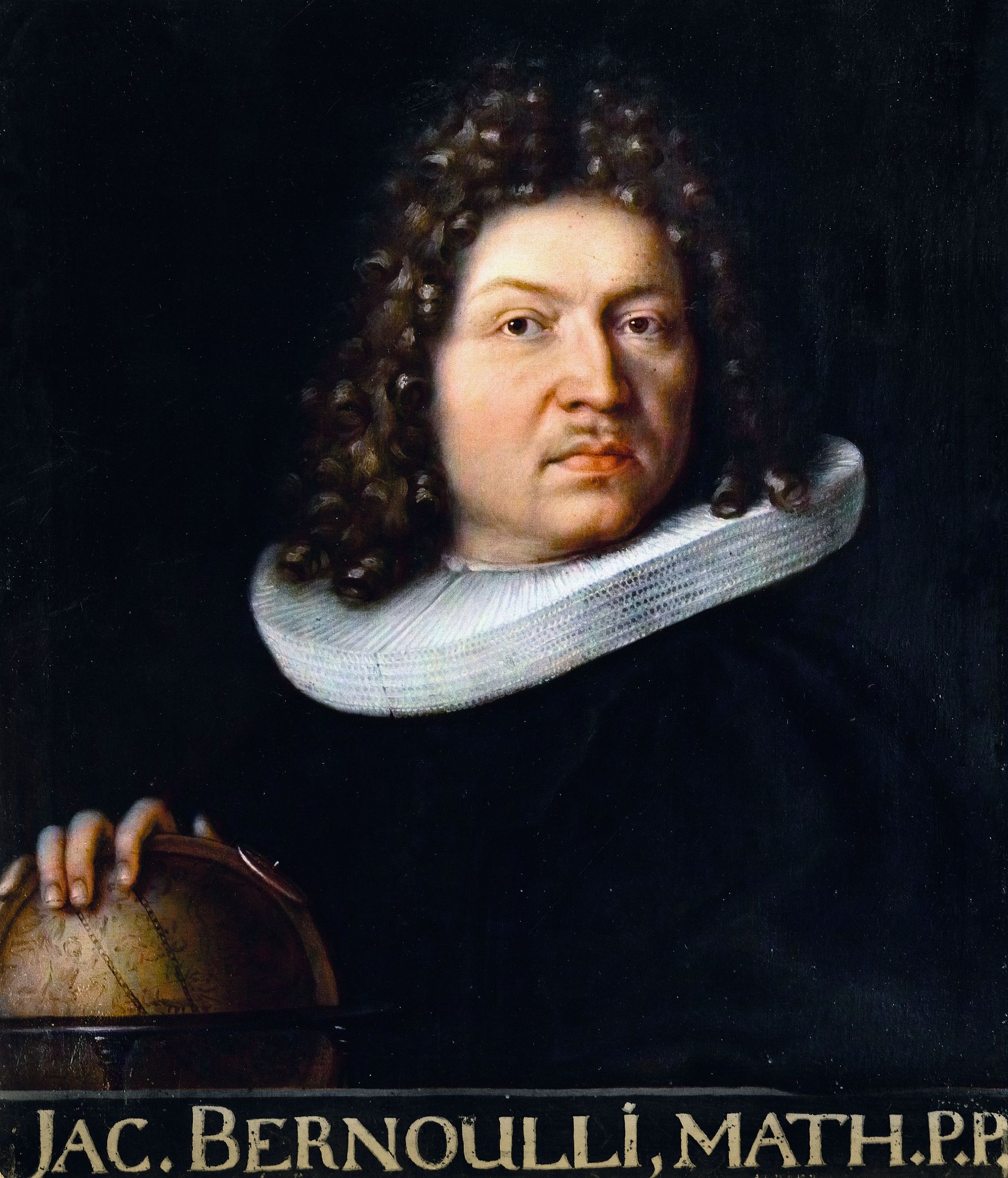
In 1683 the Swiss mathematician Jacob Bernoulli asked a question about money. It is the kind of question a careful bank customer might ask. To follow it, we only need to know how interest works, so let us start there.
1. Bernoulli's question
How interest works
When you put money in a bank, the bank pays you interest: extra money, as a reward for letting it use yours. Interest is usually given as a percentage. "Per cent" means "out of a hundred". So 10% interest on ₹100 is ₹10.
Bernoulli imagined a wildly generous bank that pays 100% interest a year. 100% means "a hundred out of a hundred", so the whole amount again. Put in ₹100, and after a year the bank adds ₹100. You have ₹200. Your money has been multiplied by 2.
Paying twice a year
Now suppose the bank says: "Instead of 100% once a year, we will pay 50% every six months." That sounds like the same thing. It is not. Watch.
- After six months, you get 50% of ₹100, which is ₹50. You now have ₹150.
- After twelve months, you get 50% again. But now it is 50% of ₹150, not of ₹100. Half of 150 is 75. So you get ₹75, and you have ₹225.
You end with ₹225 instead of ₹200. The extra ₹25 came because the first ₹50 of interest started earning interest of its own. Interest that earns interest is called compound interest.
A neater way to write it
Adding 50% to an amount is the same as multiplying it by 1.5. (The amount itself is 1 times the amount, and 50% more is 0.5 times the amount. Together, that is 1.5 times.) So the two payments did this:
₹100 \times 1.5 \times 1.5 = ₹100 \times 2.25 = ₹225
Multiplying a number by itself several times is written with a small raised number, called a power. 1.5 \times 1.5 is written 1.5^2, read "1.5 to the power 2", or "1.5 squared". 1.5 \times 1.5 \times 1.5 would be 1.5^3, "1.5 to the power 3". The raised number says how many times to multiply.
From now on, let us start with just ₹1, to keep things simple. Then:
- Paid once: ₹1 × 2 = ₹2.
- Paid twice: each payment is half of 100%, so ₹1 is multiplied by 1 + \frac12 = 1.5, twice. ₹1 becomes 1.5^2 = 2.25.
- Paid four times: each payment is a quarter of 100%, so ₹1 is multiplied by 1 + \frac14 = 1.25, four times. ₹1 becomes 1.25^4 = 2.4414.
You can see the pattern. Split the year into n equal parts. (The letter n just stands for "however many parts you choose".) Each part pays one n-th of 100%, which multiplies your money by 1 + \frac1n. That happens n times. So ₹1 becomes:
\left(1 + \frac1n\right)^n
Read it aloud: "one plus one over n, all to the power n". It means "multiply 1 + \frac1n by itself, n times".
Bernoulli's question, and its answer
More payments help, because interest starts earning interest sooner. So Bernoulli asked: what if the bank paid every month? Every day? Every second? At every instant? Would your ₹1 grow without any limit?
Here are the answers, worked out.
| Paid | Number of parts n | ₹1 becomes |
|---|---|---|
| once a year | 1 | 2.00000 |
| twice a year | 2 | 2.25000 |
| every quarter | 4 | 2.44141 |
| every month | 12 | 2.61304 |
| every day | 365 | 2.71457 |
| every hour | 8,760 | 2.71813 |
| every minute | 525,600 | 2.71828 |
The amount keeps going up. But it goes up by less and less each time. Going from yearly to monthly added 61 paise. Going from hourly to every minute added less than a fiftieth of a paisa. The numbers are settling down towards a fixed number that starts 2.71828.

Try it yourself. The plot below shows \left(1 + \frac1n\right)^n for every n from 1 to 60.
So the answer to Bernoulli's question is no. Paying interest at every instant does not make you infinitely rich. ₹1 becomes about ₹2.71828, and no amount of extra paying can push it higher. That number is called e.
e = \lim_{n\to\infty}\left(1 + \frac1n\right)^n = 2.718281828459045\ldots
The new symbol, \lim_{n\to\infty}, is read "the limit as n goes to infinity". It means: "the value that this gets closer and closer to, as you make n bigger and bigger without end" (Chapter 5.1). The sign \infty means "infinity", which here just means "no end".
2. Why it settles down, instead of growing forever
There are two forces pulling against each other here. More payments push the total up. But each payment gets smaller, which holds it down. Why does the result settle at a fixed number, instead of growing forever? To see it, we open up the bracket and look inside.
Opening up a bracket: small cases first
Let us see what (1 + x)^2, (1 + x)^3 and so on look like when you multiply them out. Here x just stands for some number.
Power 2. (1 + x)^2 means (1 + x) \times (1 + x). Multiply each part of the first bracket by each part of the second:
(1 + x)(1 + x) = 1 + x + x + x^2 = 1 + 2x + x^2
Power 3. Multiply that answer by one more (1 + x):
(1 + 2x + x^2)(1 + x) = 1 + 2x + x^2 + x + 2x^2 + x^3 = 1 + 3x + 3x^2 + x^3
Power 4. Do it once more and you get 1 + 4x + 6x^2 + 4x^3 + x^4.
Look at the numbers in front: 1, 2, 1, then 1, 3, 3, 1, then 1, 4, 6, 4, 1. Where do they come from?
Think about (1 + x)^3 = (1 + x)(1 + x)(1 + x). To make one piece of the answer, you choose either the 1 or the x from each of the three brackets, and multiply your choices.
- To get x^2, you must choose x from exactly two of the three brackets and 1 from the other one. There are 3 ways to do that: you can leave out the first bracket, or the second, or the third. So the answer has 3x^2.
- To get x^3, you must choose x from all three. There is only 1 way. So the answer has 1x^3.
So the number in front of x^k is the number of ways to choose k brackets out of all of them. Chapter 7.1 counts those ways in general. The number of ways to choose k things out of n is written \binom{n}{k}, read "n choose k". The answer is:
\binom{n}{k} = \frac{n \times (n-1) \times (n-2) \times \cdots}{1 \times 2 \times 3 \times \cdots \times k}
On top, you multiply k numbers, counting down from n. On the bottom, you multiply the numbers from 1 up to k. Check it with n = 3 and k = 2: the top is 3 \times 2 = 6, the bottom is 1 \times 2 = 2, and 6 \div 2 = 3. That matches the 3 we counted.
The bottom, 1 \times 2 \times 3 \times \cdots \times k, comes up so often that it has its own short name. It is written k! and read "k factorial". So 1! = 1, 2! = 2, 3! = 6, 4! = 24, and 5! = 120. By agreement, 0! = 1.
This whole rule for opening up (1 + x)^n is called the binomial theorem (Chapter 2.2).
Opening up Bernoulli's bracket
Now put x = \frac1n. Write out the first four terms of \left(1 + \frac1n\right)^n:
1 \;+\; n \times \frac1n \;+\; \frac{n(n-1)}{2!} \times \frac{1}{n^2} \;+\; \frac{n(n-1)(n-2)}{3!} \times \frac{1}{n^3} \;+\; \cdots
Let us look at each term.
- The first term is 1.
- The second term is n \times \frac1n = 1.
- The third term. Split the n^2 on the bottom into n \times n, and put one n under each number on top:
\frac{n(n-1)}{n \times n} = \frac{n}{n} \times \frac{n-1}{n} = 1 \times \left(1 - \frac1n\right)
So the third term is \frac{1}{2!} times \left(1 - \frac1n\right).
- The fourth term. Split the n^3 into three n's in the same way:
\frac{n(n-1)(n-2)}{n \times n \times n} = 1 \times \left(1 - \frac1n\right) \times \left(1 - \frac2n\right)
So the fourth term is \frac{1}{3!} times \left(1 - \frac1n\right)\left(1 - \frac2n\right).
Every later term works the same way. The term number k + 1 is \frac{1}{k!}, multiplied by a "correction" made of brackets like \left(1 - \frac1n\right).
Each bracket is a little less than 1. For example, if n = 100, then 1 - \frac1{100} = 0.99. So each correction is a little less than 1. As n gets bigger, \frac1n and \frac2n get smaller and smaller, so each bracket gets closer and closer to exactly 1.
That tells us two important things.
Fact 1: the total can never go above 3
Each correction is less than 1. So each term is less than \frac{1}{k!}. So the whole total is less than:
1 + 1 + \frac{1}{2!} + \frac{1}{3!} + \frac{1}{4!} + \cdots
Now compare each \frac{1}{k!} with a simple halving pattern:
| k | \frac{1}{k!} | Halving pattern | Which is smaller? |
|---|---|---|---|
| 1 | 1 | 1 | equal |
| 2 | \frac12 | \frac12 | equal |
| 3 | \frac16 | \frac14 | \frac16 is smaller |
| 4 | \frac{1}{24} | \frac18 | \frac{1}{24} is smaller |
| 5 | \frac{1}{120} | \frac{1}{16} | \frac{1}{120} is smaller |
The factorials grow faster than the doubling numbers 1, 2, 4, 8, 16. That is because each step multiplies a factorial by 3, 4, 5 and so on, but multiplies the doubling numbers only by 2. So each \frac{1}{k!} is never bigger than the halving pattern.
So the total is less than 1 + \left(1 + \frac12 + \frac14 + \frac18 + \cdots\right). The halving sum in the bracket is exactly 2. Picture walking towards a wall 2 metres away. Walk 1 metre, then half a metre, then a quarter. Each step covers half of what is left. You get closer and closer to the wall but never pass it. So the bracket adds up to 2, and the whole total is less than 1 + 2 = 3.
So however often the bank pays, ₹1 can never become more than ₹3.
Fact 2: the total keeps going up
As n grows, every bracket like \left(1 - \frac1n\right) gets a little closer to 1. So every term gets a little bigger. Also, a bigger n adds new terms at the end. So the total keeps rising.
Putting the two facts together
A list of numbers that keeps rising but can never pass 3 must settle down on some particular number. It cannot keep rising forever, because it would pass 3. It cannot jump around, because it only goes up. So it must close in on some value. Chapter 1.7 calls this property of the number line completeness. The value it closes in on is e.
A much faster recipe
As n grows, all the corrections become exactly 1. Then each term becomes just \frac{1}{k!}. So e is also this sum:
e = 1 + 1 + \frac{1}{2!} + \frac{1}{3!} + \frac{1}{4!} + \cdots
The sign \sum is often used to write this more briefly. It is the Greek capital letter sigma, and it means "add up":
e = \sum_{k=0}^{\infty}\frac{1}{k!}
Read it as "the sum, for k from 0 to infinity, of one over k factorial".
This sum closes in on e astonishingly fast, because factorials grow so fast and their fractions shrink so fast.
| Add up to | Total |
|---|---|
| \frac{1}{2!} | 2.5 |
| \frac{1}{4!} | 2.70833 |
| \frac{1}{6!} | 2.71806 |
| \frac{1}{8!} | 2.7182788 |
| \frac{1}{10!} | 2.7182818 |
Eleven terms give seven correct digits. Paying interest every minute for a whole year, which is over half a million multiplications, gave only six. It is the same number, with a far better recipe.
3. The second face of e: growing at a rate equal to its size
Bernoulli's question gave us a number. The reason that number matters so much only became clear later, when calculus arrived.
Growing at any rate
So far the bank paid 100% a year. Suppose it pays a different rate instead. Write the rate as x: 0.05 for 5%, 0.5 for 50%, 1 for 100%. Split the year into n parts as before. Each part multiplies your money by 1 + \frac{x}{n}, and that happens n times. As n grows, ₹1 becomes e^x, read "e to the power x".
Opening up the bracket exactly as before, but with x in place of 1, gives:
e^x = 1 + x + \frac{x^2}{2!} + \frac{x^3}{3!} + \frac{x^4}{4!} + \cdots
If you put x = 1, you get back the sum for e from section 2.
What a "rate of change" is
Picture a car. Its speed tells you how fast its distance is changing. If it is doing 60 km per hour, then in one hour its distance goes up by 60 km.
Any changing quantity has a speed like this. It is called the rate of change, or the derivative (Chapter 5.2). On a graph, it is how steep the curve is at that point. A steep curve is changing fast. A flat curve is not changing at all.
There is one simple rule we need, for powers of x:
The rate of change of x^k is k \times x^{k-1}.
Check it with x^2. The rule says its rate is 2x. At x = 3, x^2 = 9. At x = 3.001, x^2 = 9.006001. So when x went up by 0.001, x^2 went up by about 0.006. That is 6 times as much. And 2x = 2 \times 3 = 6. The rule works.
Here is a picture of why. A square of side x has area x^2. Make the side a tiny bit longer. The area grows by a thin strip along two of its edges. Each edge is x long, so the new area is about 2x times the tiny increase. That is the "2x".
The rate of change of e to the x
Now apply the rule to each term of e^x, one at a time.
- 1 never changes, so its rate is 0.
- x changes at rate 1.
- \frac{x^2}{2!} changes at rate \frac{2x}{2!}. Since 2! = 2, this is just x.
- \frac{x^3}{3!} changes at rate \frac{3x^2}{3!}. Since 3! = 3 \times 2!, the 3 cancels, leaving \frac{x^2}{2!}.
- \frac{x^4}{4!} changes at rate \frac{4x^3}{4!}. Since 4! = 4 \times 3!, the 4 cancels, leaving \frac{x^3}{3!}.
Look at what happened. Each term turned into the term before it. So when you add them all up, the rate of change of the whole list is the whole list again:
\text{rate of change of } e^x = e^x
This is the most important fact about e. The quantity e^x always grows at a rate equal to its own size. When it is 5, it is growing at 5 per step. When it is a million, it is growing at a million per step. No other function does this, apart from e^x multiplied by a fixed number.
Why e, and not 2 or 10?
You might ask: what about 2^x, or 10^x? They grow faster when they are bigger, too. What is special about e?
Every curve like 2^x or 10^x grows at a rate proportional to its size. "Proportional" means "equal to its size times some fixed number". The question is what that fixed number is. To find it, look at how steep each curve is where it crosses the vertical axis, at x = 0. There, each curve has the value 1, so its steepness is that fixed number.
You can measure the steepness with a calculator. Take a tiny step, like 0.001, and see how much the curve rises:
- For 2: 2^{0.001} = 1.000693. It rose by 0.000693 in a step of 0.001. Steepness: 0.693.
- For 3: 3^{0.001} = 1.001099. Steepness: about 1.099.
- For e: e^{0.001} = 1.0010005. Steepness: about 1.000.
| Base | Steepness at x = 0 |
|---|---|
| 2 | 0.693 |
| 3 | 1.099 |
| e | exactly 1 |
Base 2 is too lazy: its steepness at the start is less than 1. Base 3 is too eager: more than 1. Somewhere between 2 and 3, there is exactly one base whose steepness is exactly 1. That base is e.
Those two numbers, 0.693 and 1.099, have names. 0.693 is the natural logarithm of 2, written \ln 2. It answers the question "what power of e gives 2?" (Chapter 1.4). In the same way, 1.099 is \ln 3.
Every growth is really e growth
Since e^{0.693} = 2, you can write 2 as a power of e. So:
2^t = \left(e^{0.693}\right)^t = e^{0.693\,t}
The middle step uses a power rule from Chapter 1.4: raising a power to another power multiplies the two powers together.
Read what this says. Doubling every year is exactly the same as growing in the e way, at a rate of 0.693 per year. There is really only one shape of growth. Different bases just stretch it. Mathematicians use e because it is the one base that needs no stretching.
Why this matters in the real world
Here is the link that makes e appear all over science. Many things in nature change at a rate that depends on how much of them there already is.
- Bacteria. Each bacterium splits in two after a while. So the more bacteria there are, the faster new ones appear.
- Radioactive material. Each atom has the same small chance of breaking apart each second. So the more atoms there are, the more break apart each second.
- A cup of tea. It cools faster when it is much hotter than the room, and slower when it is only a little hotter.
- A medicine in your blood. Your kidneys and liver remove a fixed share of it each hour. So the more there is, the more is removed.
All four say the same thing: the rate of change is some fixed number times the amount. Call the amount y, the time t, and the fixed number k. Chapter 6.1 writes it like this:
\frac{dy}{dt} = k\,y
The left side, \frac{dy}{dt}, is the usual way to write "the rate of change of y as time goes on". The whole line reads: "the rate of change of y is k times y". When k is positive, the thing grows. When k is negative, it shrinks.
The answer is always:
y = y_0 \, e^{kt}
Here y_0, read "y nought", is the amount you start with. You can check it. We showed that e^x grows at a rate equal to itself. If you replace x by kt, the clock runs k times as fast, so the rate is multiplied by k. The rate of y_0 e^{kt} is then k \times y_0 e^{kt}, which is k times y. That is exactly what the law asked for.
So e is not really a number about money. It is the number of anything whose change depends on how much there is. That is one of the most common patterns in nature. Every time it shows up, e comes with it.
4. The third face: the area under the curve 1/x
There is one more place to meet e. Historically, it came first.
The curve
Draw the curve y = \frac1x. At x = 1 its height is 1. At x = 2 its height is \frac12. At x = 4 its height is \frac14. It slopes down towards the floor but never reaches it.
Now measure the area under this curve, starting from x = 1 and going to the right.
Saint-Vincent's discovery
In 1647 the Belgian mathematician Grégoire de Saint-Vincent noticed something strange about this area. The area from 1 to 2 is exactly the same as the area from 2 to 4, and the same as the area from 4 to 8.
Here is why. Take the piece of area between 1 and 2. Now stretch it sideways so that it reaches from 2 to 4. It becomes twice as wide. But over there, the curve is only half as high, because \frac1x halves when x doubles. Twice as wide and half as high: the area stays the same.
So every time you multiply the distance by 2, you add the same fixed amount of area. Multiplying turning into adding is exactly how a logarithm behaves (Chapter 1.4). For example, \log_{10} 100 = 2 and \log_{10} 1000 = 3: multiplying by 10 adds 1. So the area under \frac1x, from 1 up to some point, is some kind of logarithm of that point.
Which logarithm?
There are logarithms to many bases (Chapter 1.4). Which one is it? Look at a very thin strip of the area, from x = 1 to x = 1.001. The curve there is about 1 high, so this thin strip has an area of about 0.001 \times 1 = 0.001.
Now, which base b has a logarithm of 1.001 equal to about 0.001? That would mean b^{0.001} \approx 1.001. From section 3, that is exactly the base whose curve has a steepness of 1 at the start. That base is e. (Check: e^{0.001} = 1.0010005.)
So the area under \frac1x from 1 to a point a is the natural logarithm, \ln a. When is that area exactly 1? When \ln a = 1, which means a = e. Written with the symbols of Chapter 5.5:
\int_1^e \frac{1}{x}\,dx = 1
The long S-shaped sign \int means "the area under", read "the integral". So this reads: "the area under one over x, from one to e, equals one".
Three faces, one number
We have now met e three ways, found by different people asking different questions.
- It is where compound interest settles when it is paid at every instant.
- It is the base whose growth curve has exactly its own steepness.
- It is the point where the area under \frac1x reaches exactly 1.
They are the same number because the calculus of Part 5 joins all three. We just saw the join between faces 2 and 3, in the thin-strip argument.
5. The story of the letter e
John Napier, 1614. The Scottish landowner John Napier spent twenty years building tables of logarithms. Astronomers then had to multiply huge numbers by hand, which took weeks and caused many mistakes. A logarithm table turns multiplying into adding, which is far quicker. Napier built his table by starting at 10,000,000 and taking away one ten-millionth of what was left, again and again. After ten million such steps, you have about 0.3678794 of what you started with. That is \frac1e. It is Bernoulli's question run backwards: shrinking by a tiny share, very many times. Napier never noticed the number, but it was built into his tables.

Jacob Bernoulli, 1683. The compound interest question of section 1. He proved the answer lies between 2 and 3.
Gottfried Leibniz, 1690. In letters to the Dutch scientist Christiaan Huygens, he wrote about this number, calling it b.
Leonhard Euler, 1727 to 1748. Euler first wrote the letter e for it in 1727 or 1728, in a handwritten paper about cannon fire. It first appeared in print in his book Mechanica in 1736. In 1748, in his great textbook on infinite processes, he gave the sum of section 2, the limit of section 1, and the value to 23 decimal places. People sometimes say he chose e for "Euler". There is no evidence of that. The most likely reason is simple: he was already using other letters for other things, and e was the next free vowel.
Chapter 11.1 tells the story of Euler's life. He is also the person who joined e to i and π in one equation, which is the subject of Chapter 11.9.
6. Why e is not a fraction
In Chapter 11.6 we saw what it means for a number to be a fraction, or not. Joseph Fourier, the French mathematician, proved in 1815 that e is not a fraction. His proof uses nothing except the sum from section 2. Let us first try a small example, so that the general proof is easy to follow.
A small example first
Suppose someone claimed that e was a fraction with 3 on the bottom, like \frac{8}{3}. Let us test that claim.
If e = \frac{8}{3}, then multiplying by 3! (which is 6) would give 6e = \frac{48}{3} = 16, a whole number. So, if the claim were true, 6e would be a whole number.
Now work out 6e using the sum instead:
6e = 6\left(1 + 1 + \frac12 + \frac16\right) + 6\left(\frac{1}{24} + \frac{1}{120} + \frac{1}{720} + \cdots\right)
- The first bracket times 6 is 6 + 6 + 3 + 1 = 16. A whole number.
- The second bracket times 6 is \frac{6}{24} + \frac{6}{120} + \frac{6}{720} + \cdots = 0.25 + 0.05 + 0.0083 + \cdots \approx 0.31. Not a whole number.
So 6e = 16.31\ldots, which is not a whole number. The claim was false. And the leftover, 0.31, is the reason: it is stuck strictly between 0 and 1.
The general proof
Fourier's proof does the same thing for any bottom number b.
Step 1. Assume it. Suppose e = \frac{a}{b}, with a and b whole numbers.
Step 2. Multiply by b!. Then b! \times e = b! \times \frac{a}{b}. Now, b! is 1 \times 2 \times \cdots \times b, so dividing it by b just removes the last number, leaving (b-1)!. So b! \times e = a \times (b-1)!. That is a whole number multiplied by a whole number. So b! \times e must be a whole number.
Step 3. Work out b! \times e with the sum. Split the sum into two parts: the terms up to \frac{1}{b!}, and all the terms after.
b! \times e = b!\left(1 + 1 + \frac{1}{2!} + \cdots + \frac{1}{b!}\right) + b!\left(\frac{1}{(b+1)!} + \frac{1}{(b+2)!} + \cdots\right)
Step 4. The first part is a whole number. Each term is \frac{b!}{k!} for some k no bigger than b. For example, \frac{6!}{4!} = \frac{720}{24} = 30. In general, b! contains all of k! inside it, so the division leaves a whole number.
Step 5. The second part is between 0 and 1. Look at its terms one by one:
- \frac{b!}{(b+1)!} = \frac{1}{b+1}, because (b+1)! is just b! times (b+1).
- \frac{b!}{(b+2)!} = \frac{1}{(b+1)(b+2)}, which is smaller than \frac{1}{(b+1)^2}.
- And so on. Each term is smaller than the matching power of \frac{1}{b+1}.
So the second part is positive, and it is less than:
\frac{1}{b+1} + \frac{1}{(b+1)^2} + \frac{1}{(b+1)^3} + \cdots
This is a shrinking sum like the halving sum, but each term is \frac{1}{b+1} of the one before instead of \frac12. We prove in Chapter 5.8 that such a sum adds up to \frac{1}{b}. Since b is at least 1, \frac1b is at most 1. So the second part is more than 0 and less than 1.
Step 6. The contradiction. From step 2, b! \times e is a whole number. From steps 4 and 5, it is a whole number plus a piece strictly between 0 and 1. A whole number plus part of 1 can never be a whole number. So the assumption in step 1 was false. e is not a fraction.
It is also transcendental, which is stronger. We met this word in Chapter 11.7. It means that no equation built from whole numbers has e as its answer. The French mathematician Charles Hermite proved this in 1873. It was the first time anyone proved that a number already in use was transcendental.
7. Surprising places where e appears
Some of the best appearances of e seem, at first, to have nothing to do with growth.
Secret Santa: the chance that nobody draws their own name
A group of friends each write their name on a slip and put it in a hat. Then each person draws one slip at random. If anyone draws their own name, the draw has to be done again. What is the chance that nobody draws their own name?
Start with three people. Call them A, B and C. There are 6 possible ways the slips can be handed out. In each row below, the first letter is the slip A drew, then B's, then C's.
| A gets | B gets | C gets | Anyone get their own? |
|---|---|---|---|
| A | B | C | yes, all three |
| A | C | B | yes, A |
| B | A | C | yes, C |
| B | C | A | no |
| C | A | B | no |
| C | B | A | yes, B |
Only 2 of the 6 work. So with three people, the chance is \frac26 = \frac13.
For a bigger group, listing every possibility is impossible. Ten people can be handed out in 3,628,800 ways. So we count cleverly instead. A hand-out where nobody gets their own name is called a derangement. We count them with a method called inclusion–exclusion. It means: start with everything, take away the bad cases, and then fix the cases you took away twice. Here it is for n people.
- All hand-outs. There are n! ways to hand out n slips. (The first person has n choices, the second has n - 1 left, and so on.)
- Take away the ones where person 1 got their own name. If person 1's slip is fixed, the other n - 1 slips can go (n-1)! ways. Do this for each of the n people. That takes away n \times (n-1)!, which is n!. We can write it as \frac{n!}{1!}.
- Add back the double-counts. A hand-out where persons 1 and 2 both got their own names was taken away twice in step 2, once for each. So add those back. There are \binom{n}{2} ways to pick two people, and (n-2)! ways to hand out the rest. That works out to \frac{n!}{2!}.
- Fix the triple-counts. Hand-outs where three people got their own name have now been taken away three times and added back three times. So they have not been taken away at all. Take them away once: subtract \frac{n!}{3!}.
- Carry on, switching between adding and subtracting, until you reach all n people.
The number of good hand-outs is:
n!\left(1 - \frac{1}{1!} + \frac{1}{2!} - \frac{1}{3!} + \cdots\right)
Divide by the total, n!, to get the chance. It is the bracket.
Check it with three people: 1 - 1 + \frac12 - \frac16 = \frac13. That matches the table.
Now look at the bracket. It is the sum for e^x from section 3, with x = -1: the powers of -1 just make the signs take turns. So as the group gets bigger, the chance gets closer and closer to e^{-1}, which is \frac1e \approx 0.3679.
| People | Chance nobody draws their own name |
|---|---|
| 3 | 0.3333 |
| 4 | 0.3750 |
| 5 | 0.3667 |
| 7 | 0.3679 |
| 10 | 0.3679 |
By seven people, the chance has settled at about 37%. Whether you have seven friends or a whole city, about 37% of draws work first time. So about 63% of Secret Santa draws have to be redone at least once.
A one-in-a-hundred chance, tried a hundred times
Suppose something has a 1-in-100 chance of happening on any one day. Over 100 days, many people would guess it is certain to happen. It is not.
- On any one day, the chance it does not happen is 1 - \frac{1}{100} = 0.99.
- The chance it does not happen on any of the 100 days is 0.99 multiplied by itself 100 times: \left(1 - \frac{1}{100}\right)^{100}.
- That is Bernoulli's bracket with a minus sign. Just as \left(1 + \frac1n\right)^n closes in on e, the bracket \left(1 - \frac1n\right)^n closes in on \frac1e \approx 0.37.
- So the chance it happens at least once is about 1 - 0.37 = 0.63, or 63%.
The exact value for 100 days is 63.4%. This "about 63%" rule works whenever you have n tries at a 1-in-n chance. It is the same 63% as the Secret Santa redraws.
Choosing the best: the 37% rule
You are looking at 100 flats to rent, one at a time. After seeing each one, you must say yes or no immediately. If you say no, that flat is gone forever. You want the very best one. What should you do?
Here is the best possible plan. Look at the first 37 flats without choosing any of them. Then choose the first flat that is better than all the ones you have seen so far. This plan picks the very best flat about 37% of the time. That may sound low, but picking at random would get the best flat only 1% of the time.
Why 37? Suppose you skip the first r flats, then take the first one that beats everything before it.
- You win only if the best flat comes after the ones you skipped. Say it is flat number i. Each position is equally likely to hold the best flat, so each has a chance of \frac{1}{100}.
- If the best flat is at i, you only reach it if nothing earlier tempted you first. Something earlier would tempt you if it beat all the skipped flats. That cannot happen if the best of the first i - 1 flats is among the skipped ones. The chance of that is \frac{r}{i-1}, because the best of those i - 1 is equally likely to be any of them, and r of them were skipped.
- Add up the chances for every possible i. You get:
\text{chance of winning} = \frac{r}{100}\left(\frac1r + \frac{1}{r+1} + \cdots + \frac{1}{99}\right)
- The bracket is a staircase of fractions \frac1k. From section 4, adding up \frac1k is very like the area under \frac1x, and the area under \frac1x from r to 100 is \ln\frac{100}{r}. So, if we write p for the fraction you skip (p = \frac{r}{100}), the chance of winning is about:
p \times \ln\frac1p
- Now try some values of p:
| Fraction skipped, p | Chance of winning |
|---|---|
| 0.10 | 0.230 |
| 0.20 | 0.322 |
| 0.30 | 0.361 |
| 0.35 | 0.367 |
| 0.37 | 0.368 |
| 0.40 | 0.367 |
| 0.50 | 0.347 |
The best is at about 0.37, which is \frac1e. Calculus confirms that the very top of this curve is exactly at p = \frac1e, and that the best chance is also exactly \frac1e. A direct count for 100 flats agrees: skip 37, and you win 37.1% of the time.
The hanging chain
Hold a necklace or a chain by its two ends and let it hang. Galileo thought the curve it makes was a parabola, the shape a thrown ball follows. He was wrong. In 1691 three mathematicians, Johann Bernoulli (Jacob's brother), Leibniz and Huygens, each found the true shape. It is called a catenary, from the Latin word for "chain".

Its equation is:
y = \frac{a}{2}\left(e^{x/a} + e^{-x/a}\right)
Here a is a fixed number set by how tightly the chain is pulled. The term e^{x/a} is a curve that rises steeply to the right. The term e^{-x/a} is the same curve flipped, rising steeply to the left. The formula takes their average. Near the middle both are small, so the chain is low. Towards either end, one of them rises fast, so the chain curves up. That gives the U shape.
Why e again? At any point on the chain, how steep it is depends on how much chain hangs beyond that point, pulling it down. And how much chain hangs there depends on how steep it is. A quantity whose change depends on itself is exactly the kind of thing that e describes. Setting up the balance of forces on one link takes the mechanics of Volume IV, Part 1. The equation that comes out is solved by this formula.
Turn a catenary upside down and you get the strongest possible shape for an arch that only has to hold up its own weight. Many domes and arches are built on it.
8. Where e shows up in your life
Your savings and your loans. Banks quote a yearly rate, but they usually add interest every month or every day. So your money grows a little faster than the quoted rate. Take a yearly rate of 12%. Paid once a year, ₹100 becomes ₹112. Paid at every instant, it becomes 100 \times e^{0.12} = ₹112.75. That is why loan papers must also state the "effective annual rate", which shows the real growth.
Your cup of tea. It cools as e^{-kt}: fast at first, then more slowly. The number k depends on the cup. After a time of \frac1k, the difference between the tea's temperature and the room's has shrunk to \frac1e, about 37% of what it was.
Every medicine you take. A tablet's level in your blood falls as e^{-kt}. That is why medicine leaflets give a half-life: the time for half of the medicine to leave your body. It is found by asking when e^{-kt} equals \frac12. The answer is t = \frac{\ln 2}{k} = \frac{0.693}{k}. Volume V, Part 22 uses this to explain why some tablets are taken once a day and others every few hours.
Your phone charger and camera flash. These contain a capacitor, a part that stores electric charge. A capacitor fills up as 1 - e^{-t/T}, where T is a time fixed by the circuit. After one time T, it is 1 - \frac1e \approx 63\% full. It is the same 63% as the hundred-day chance. Volume III, Part 1 builds on it.
Carbon dating. Living things take in a slightly radioactive kind of carbon, called carbon-14. When they die, they stop taking it in, and what they have decays as e^{-kt}. Measuring how much is left in an old bone tells you how long ago it died. Volume IV, Part 9 works through it.
e is the number of growth. π is the number of turning. They seem to belong to completely separate worlds. The next page shows that they are joined by a number that was once called impossible. Next: 11.9 — i.