Appearance
11.11 — The Rest of the Cast: 0, 1, √3, ln 2, γ and the Unknowns
Collect stickers for a 50-sticker album, buying one random sticker at a time. How many will you buy, on average, before the album is full? The answer is about 225, not 50. Most of them will be repeats.
The number that controls that answer is called \gamma. It is one of a handful of constants that sit just behind the famous five of the last five chapters. Each one answers a real question, and one of them holds the oldest embarrassment in mathematics: we do not know whether it is a fraction.
1. 0 and 1: the numbers that do nothing
Euler's identity, e^{i\pi} + 1 = 0, contains five constants. Chapters 11.7 to 11.9 dealt with e, i and π. The other two are 0 and 1, and their jobs are simpler but just as basic.
0 is the number that changes nothing when you add it. 7 + 0 = 7 for every number. Mathematicians call this the additive identity, where "identity" means "leaves things identical".
1 is the number that changes nothing when you multiply by it. 7 \times 1 = 7 for every number. It is the multiplicative identity.
These sound too obvious to matter. But every other number is defined by how it relates to them. -7 is the number that adds to 7 to give 0. \frac17 is the number that multiplies with 7 to give 1. Chapter 1.1 tells the long story of how hard zero was to accept. India gave it to the world as a true number, with rules for calculating with it, in Brahmagupta's book of 628 CE.
In the turning picture of Chapter 11.9, 1 is the point where every turn starts and ends. A full turn, e^{2\pi i}, brings you back to 1. So e^{i\pi} + 1 = 0 says in symbols: "half a turn from the starting point, plus the starting point, gives nothing".
2. √3 and the equilateral triangle
\sqrt2 is the diagonal of a square. \sqrt3 \approx 1.732 belongs to the next simplest shape, the equilateral triangle, which has all three sides equal and all three angles 60°.
Take one with sides of length 1. Drop a line from the top straight down to the middle of the base. It splits the triangle into two right triangles, each with a long side of 1 and a base of \frac12. By Pythagoras, the height h satisfies:
h^2 + \left(\tfrac12\right)^2 = 1^2 \quad\Longrightarrow\quad h^2 = \tfrac34 \quad\Longrightarrow\quad h = \frac{\sqrt3}{2} \approx 0.866
This is why \sin 60° = \frac{\sqrt3}{2} and \tan 60° = \sqrt3 in Chapter 3.5. It is also why honeycomb cells, which are hexagons made of six equilateral triangles, carry \sqrt3 in every measurement. And it is irrational, by exactly the argument used for \sqrt2 in Chapter 11.6.
Where you meet it: the 400-volt supply
Large buildings in India get a three-phase supply. It has three live wires instead of one. Each wire carries 230 volts compared with the neutral wire, but the three swing a third of a cycle apart. In Chapter 11.9 we saw that each swing can be drawn as a turning arrow. So the three arrows are 230 long and point 120° apart.
Measured between two live wires, the voltage is the gap between the tips of two of those arrows. So we have a triangle: two sides of 230, with an angle of 120° between them. We want the third side.
If the angle were a right angle, Pythagoras would do it. For any other angle there is a version of Pythagoras with a correction term, called the law of cosines (Chapter 3.5). For two sides a and b with an angle C between them, the third side c obeys:
c^2 = a^2 + b^2 - 2ab\cos C
When C is a right angle, \cos C = 0, the correction vanishes, and this is just Pythagoras. For wider angles the correction makes the third side longer.
We need \cos 120°. Recall from Chapter 11.9 that the cosine of an angle is how far across you are after turning that far round a circle of radius 1. 120° is a third of a turn. That takes you past the top, into the left half of the circle, at exactly half a step to the left of centre. So \cos 120° = -\frac12.
Now put in a = b = 230 and \cos C = -\frac12:
c^2 = 230^2 + 230^2 - 2 \times 230 \times 230 \times \left(-\tfrac12\right)
The last term is -2 \times 230^2 \times (-\frac12) = +230^2. So:
c^2 = 230^2 + 230^2 + 230^2 = 3 \times 230^2
Take the square root of both sides: c = 230 \times \sqrt3 \approx 230 \times 1.732 = 398 volts. That is the "400-volt" supply you see on industrial machines.
3. ln 2: the number of doubling
The natural logarithm of 2 is:
\ln 2 = 0.693147\ldots
It answers the question "to what power must e be raised to give 2?" (Chapter 1.4). It turns up every time something doubles or halves. In Chapter 11.8 we saw that all growth is e growth underneath, and that is the reason.
Doubling time and half-life. In Chapter 11.8 we saw that anything growing in proportion to its size grows like e^{kt}, where t is time and k is its growth rate. When has it doubled? When e^{kt} = 2. Now ask: "e to what power gives 2?" The answer is, by definition, \ln 2. So the power kt must equal \ln 2. Divide both sides by k to get the time. So the doubling time is:
t_{\text{double}} = \frac{\ln 2}{k} \approx \frac{0.693}{k}
The same formula gives the half-life of anything decaying as e^{-kt}. If money grows at 7% a year, k = 0.07, and it doubles in about \frac{0.693}{0.07} \approx 10 years. Chapter 1.4 derives the "rule of 72" from this: bankers round 69.3 up to 72 because 72 divides neatly by 2, 3, 4, 6, 8, 9 and 12.
An endless sum. \ln 2 is also the total of this sum, where the signs take turns:
1 - \frac12 + \frac13 - \frac14 + \frac15 - \cdots = \ln 2
Here is where that comes from. It uses exactly the same four steps as Madhava's sum for π in Chapter 11.7, so you can follow it with that page open beside you.
- How fast it changes. In Chapter 11.8 we saw that the area under \frac1x from 1 to a point is \ln of that point. So as you move the point, the area grows at a rate equal to the height of the curve there. At the point 1 + x, the height is \frac{1}{1 + x}. So \ln(1 + x) changes at rate \frac{1}{1+x}.
- Turn that into an endless sum. In Chapter 11.7 we saw that \frac{1}{1 - r} = 1 + r + r^2 + \cdots. Put r = -x. Then \frac{1}{1 + x} = 1 - x + x^2 - x^3 + \cdots
- Add up the changes. Use the rule from Chapter 11.7. A rate of x^k adds up to \frac{x^{k+1}}{k+1}. Each piece adds up in turn. The piece 1 gives x. The piece x gives \frac{x^2}{2}. The piece x^2 gives \frac{x^3}{3}. The same goes on for every piece. We also know that \ln 1 = 0, so we start from zero:
\ln(1 + x) = x - \frac{x^2}{2} + \frac{x^3}{3} - \frac{x^4}{4} + \cdots
- Put in x = 1. Every power of 1 is 1. The left side becomes \ln 2. That is the sum.
Compare it with the sum without the alternating signs, 1 + \frac12 + \frac13 + \cdots. That one grows forever, and Chapter 8.5 gives the proof. The alternating signs are what tame it. The next section is about how fast the plain version grows.
4. γ: the gap that nobody can explain
The harmonic numbers are the sums of the fractions \frac1k:
H_n = 1 + \frac12 + \frac13 + \cdots + \frac1n
Read aloud: "H n is one, plus a half, plus a third, and so on up to one over n". They grow forever, but very slowly. H_{10} is about 2.93. H_{1000} is only about 7.49.
In Chapter 11.8 we saw that the area under the curve y = \frac1x, from 1 to n, is \ln n. The harmonic sum looks like a staircase version of that same area. So compare them. Subtract one from the other:
| n | H_n - \ln n |
|---|---|
| 10 | 0.62638 |
| 100 | 0.58221 |
| 1,000 | 0.57772 |
| 1,000,000 | 0.57722 |
The gap does not grow and does not vanish. It settles on a fixed number:
\gamma = \lim_{n\to\infty}\left(H_n - \ln n\right) = 0.5772156649\ldots
This is the Euler–Mascheroni constant, written with the Greek letter γ, "gamma". Euler found it in 1734. Later in life he computed it to 16 decimal places. The Italian Lorenzo Mascheroni computed more digits in 1790, and got some of them wrong.
Why the gap settles: a picture
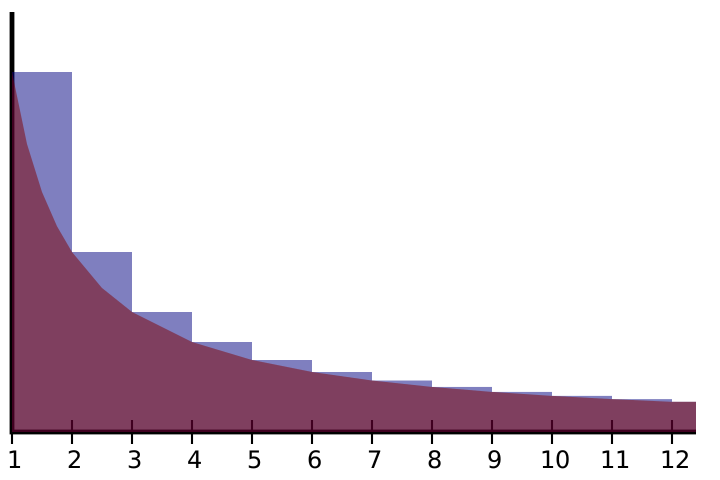
Here is how to read the figure. Over each stretch from k to k+1, stand a rectangle of width 1 and height \frac1k. Its area is \frac1k, so all the rectangles together make the harmonic sum. The curve y = \frac1x runs underneath them, because it starts at height \frac1k and falls. So each rectangle has a small shaded piece sticking out above the curve.
The total of those shaded pieces is the gap between the harmonic sum and \ln n. Now two simple facts finish the argument.
The total keeps rising. Each new step adds one more shaded piece, and every piece has positive area.
The total can never pass 1. Look at one shaded piece, over the stretch from k to k + 1. At the left edge of that stretch the curve is at height \frac1k, the top of the rectangle. At the right edge it has dropped to \frac{1}{k+1}. So the shaded piece fits inside a little box 1 wide and \frac1k - \frac{1}{k+1} tall. That is how far the curve drops across the stretch.
Now slide every one of those little boxes to the left, into the first column, between x = 0 and x = 1, and stack them. The first box runs from height \frac12 up to 1. The second runs from \frac13 up to \frac12, so it sits exactly under the first. The third runs from \frac14 up to \frac13, exactly under the second. They stack perfectly, with no gaps and no overlaps, filling the column from 1 all the way down towards 0. So all the boxes together have an area of at most 1 \times 1 = 1. The shaded pieces sit inside the boxes, so their total is less than 1.
A total that keeps rising but can never pass 1 must settle on a number, by the completeness of Chapter 1.7. That number is \gamma.
Where you meet it: collecting a full set
Back to the sticker album. Suppose there are n different stickers, each equally likely, and you buy one at a time.
- Your first sticker is always new.
- When you have k different stickers, a new purchase is one you do not have with chance \frac{n-k}{n}. For example, with 50 stickers in the album and 40 already collected, 10 of the 50 possible stickers are new to you. So the chance is \frac{10}{50} = \frac15.
- How long do you wait for something with chance \frac15? Think of rolling a die and waiting for a six, which has chance \frac16. In the long run, one roll in six is a six, so on average you wait 6 rolls. In the same way, a chance of \frac15 means waiting about 5 tries. In general, a chance p means waiting \frac1p tries on average (the proof is in Chapter 7.5). So you wait \frac{n}{n-k} purchases for the next new sticker. With 40 of 50, that is \frac{50}{10} = 5 purchases.
- Add the waits for every stage, from k = 0 up to k = n - 1:
\frac{n}{n} + \frac{n}{n-1} + \cdots + \frac{n}{1} = n\left(1 + \frac12 + \cdots + \frac1n\right) = n\,H_n
- And H_n is about \ln n + \gamma. So you expect to buy about:
n\,(\ln n + \gamma)
For 10 different toys in cereal boxes, that is 10 \times (2.303 + 0.577) \approx 29 boxes. For a 50-sticker album, it is about 224, and the exact value 50 H_{50} is 225. The last few stickers take most of the time. When you have 49, you need on average 50 more purchases to find the last one.
The great unknown
\gamma is used everywhere in number theory and in physics. Yet nobody knows whether \gamma is a fraction. It is one of the most famous unsolved questions in mathematics. Computers have found billions of its digits, and if it were a fraction, its bottom number would have to be enormous. But no proof exists either way. Compare e, which we proved irrational in half a page in Chapter 11.8. \gamma has resisted everyone for nearly three hundred years.
5. Two more constants worth knowing
Apéry's constant, ζ(3)
Chapter 11.1 tells how Euler found that 1 + \frac{1}{2^2} + \frac{1}{3^2} + \cdots = \frac{\pi^2}{6}. He found exact answers for the fourth powers, the sixth powers, and every even power, each one a fraction times a power of π. Mathematicians write these sums as \zeta(2), \zeta(4) and so on. The symbol \zeta is the Greek letter "zeta".
The odd powers would not give in. The sum of the reciprocal cubes is:
\zeta(3) = 1 + \frac{1}{2^3} + \frac{1}{3^3} + \cdots = 1.2020569\ldots
Nobody has ever found a formula for it in terms of π or any other known constant. In 1978 the French mathematician Roger Apéry proved that at least it is irrational. His proof was so unexpected that the audience at his first lecture did not believe it until others had checked it. For the fifth powers, \zeta(5), even that much is unknown.
Feigenbaum's constant, δ
Imagine a population of fish in a pond, counted once a year. Here is a simple rule for how it changes, from Chapter 6.3. Write the population as a fraction x of the most the pond can hold, so x is between 0 and 1. Then next year's fraction is:
x_{\text{next}} = r \times x \times (1 - x)
The number r is a setting: how fast the fish breed. The (1 - x) part slows things down when the pond gets crowded.
Start with any x and apply the rule year after year. What happens depends on the setting r.
- With r below 3, the population settles to one steady value.
- Just above 3, it stops settling. It flips between two values: high one year, low the next. That is called a period doubling, because the pattern now takes two years to repeat instead of one.
- At about 3.449, it doubles again. Now it cycles through four values.
- At about 3.544, eight values. At about 3.564, sixteen.
- By about 3.57, the doublings have piled up infinitely fast, and the population jumps around with no pattern at all. That is chaos.
The doublings come faster and faster. In 1975, Mitchell Feigenbaum measured how much faster. Take the gaps between doubling points: from 3 to 3.449 is a gap of 0.449; from 3.449 to 3.544 is 0.095; from 3.544 to 3.564 is 0.020. Divide each gap by the next: 0.449 \div 0.095 = 4.75, then 0.095 \div 0.020 = 4.66. The ratios settle on one number:
\delta = 4.6692016\ldots
The surprise is that the same number appears for every system that reaches chaos this way, whatever it is made of. In 1980, the French physicist Albert Libchaber measured it in the flow of heated liquid helium and got a value close to 4.4, within the accuracy of his experiment. A number found with a pocket calculator described a real fluid. Chapter 6.3 calls this universality.
6. What we know and do not know
Here is the honest state of knowledge for every constant in this chapter and the five before it.
| Number | Irrational? | Transcendental? |
|---|---|---|
| \sqrt2, \sqrt3, \varphi | proved | no: each solves a simple equation |
| π | proved, 1761 | proved, 1882 |
| e | proved, 1737 | proved, 1873 |
| e^\pi | proved | proved, 1934 |
| \ln 2 | proved | proved, 1882 |
| \zeta(3) | proved, 1978 | unknown |
| \gamma | unknown | unknown |
| \pi + e | unknown | unknown |
| \pi \times e | unknown | unknown |
Here is how to read the table. "Irrational" means "not a fraction" (Chapter 11.6). "Transcendental" means "not the answer to any equation built from whole numbers" (Chapter 11.7). Every transcendental number is also irrational, but not the other way round: \sqrt2 is irrational, but it is the answer to "x \times x = 2".
The e row says 1737 because Euler first proved e irrational then, using its tower of fractions. Fourier's simpler proof in Chapter 11.8 came later.
The \ln 2 row comes from Lindemann's rule, explained in Chapter 11.9. That rule says: e raised to a power (other than zero) that solves a whole-number equation never itself solves one. Now e^{\ln 2} = 2, and 2 certainly solves one (x - 2 = 0). So the power, \ln 2, cannot solve one. It is transcendental.
The e^\pi row is a nice one. In Chapter 11.9 we saw that i^i = e^{-\pi/2}. Raise both sides to the power -2. Using the power-of-a-power rule, the right side becomes e^{-\pi/2 \times -2} = e^{\pi}. So e^\pi is i raised to the power -2i. In 1934 the Russian mathematician Aleksandr Gelfond proved a rule about numbers of exactly that kind. Take a number that solves a whole-number equation, and raise it to the power of another such number. As long as that power is not a plain fraction, the result is always transcendental. So e^\pi is too. But nobody can say the same about the sum \pi + e, a far simpler-looking number. Simple to write is not the same as simple to understand.
7. Where these show up in your life
Every sticker album, card set and "collect all ten" offer. Shops rely on the n\,(\ln n + \gamma) rule. A full set always costs far more than the number of items, and the last few are the expensive part.
Every "doubles in" headline. Whenever you read that prices, a population, or an infection count doubles every so many days, the \ln 2 is inside the calculation.
Every three-phase motor and lift. The 400 volts between the live wires of a building's supply is 230\sqrt3.
Every honeycomb, and every tiled floor of hexagons. \sqrt3 is in every measurement.
Twelve numbers, from twelve different questions, and we have kept seeing the same few appear in each other's formulas. The last page asks why, and asks how these numbers, forced by pure logic, differ from the measured numbers of physics, such as the speed of light. Next: 11.12 — Why the Same Few Numbers Run the Universe.