Appearance
11.9 — i: The Number That Turns
In 1545 the Italian doctor, gambler and mathematician Gerolamo Cardano published a book called Ars Magna, which means "The Great Art". In it he set himself a little puzzle:
Split the number 10 into two parts, so that the two parts multiplied together make 40.

1. A puzzle with no answer
Let us try Cardano's puzzle. "Split 10 into two parts" means two numbers that add up to 10.
| Two parts | They add to | They multiply to |
|---|---|---|
| 1 and 9 | 10 | 9 |
| 3 and 7 | 10 | 21 |
| 4 and 6 | 10 | 24 |
| 5 and 5 | 10 | 25 |
The product grows as the two parts get closer together. It is biggest when they are equal, at 5 and 5, and then it is only 25. So 40 seems impossible.
Cardano followed the algebra anyway. Here is what he did, one step at a time.
Step 1. Write the parts with a letter. Any two parts of 10 can be written as 5 + x and 5 - x, for some number x. For example, x = 2 gives 7 and 3. These always add to 10, because the +x and the -x cancel: (5 + x) + (5 - x) = 10.
Step 2. Multiply them. Multiply each part of the first bracket by each part of the second:
(5 + x)(5 - x) = 25 - 5x + 5x - x^2 = 25 - x^2
The middle two pieces cancel. Here x^2 means x \times x.
Step 3. Make it equal 40. We want 25 - x^2 = 40. Take 25 from both sides: -x^2 = 15. Multiply both sides by -1:
x^2 = -15
So we need a number which, multiplied by itself, gives -15. But every number you know, multiplied by itself, gives a positive answer or zero. 3 \times 3 = 9. (-3) \times (-3) = 9 too, because a negative times a negative is positive (Chapter 1.2). No ordinary number squared gives -15.
Step 4. Carry on anyway. Cardano wrote the answer as x = \sqrt{-15}, "the square root of minus fifteen", as if it existed. Then the two parts are:
5 + \sqrt{-15} \qquad\text{and}\qquad 5 - \sqrt{-15}
Step 5. Check. Do they add to 10? Yes, the \sqrt{-15} parts cancel. Do they multiply to 40? From step 2, the product is 25 - x^2. Here x^2 = -15, because x is the square root of -15. So the product is 25 - (-15) = 25 + 15 = 40. It works!
It works, if you allow yourself a number whose square is negative. Cardano called his answer "as subtle as it is useless" and moved on.
Chapter 2.5 tells what happened next. In 1572, the Italian engineer Rafael Bombelli was solving a cubic equation, an equation with x \times x \times x in it. Its answer was an ordinary whole number, 4. But the standard formula for solving it produced square roots of negative numbers along the way. Bombelli kept calculating with them, and they cancelled out to give 4. So these strange numbers were not useless at all. They were a hidden step on the way to real answers. Chapter 2.5 also teaches how to add and multiply them.
That leaves four questions. Why must such a number exist? Why did it take 250 years to be accepted? How does it join e and π? And why can physics not work without it?
2. Why i has to exist
The basic building block is the square root of -1. Mathematicians call it i, for "imaginary":
i \times i = -1
Every other square root of a negative number comes from it. For example, \sqrt{-15} is just \sqrt{15} \times i.
The question "what number squared gives -1?" sounds like a trick, because the honest first answer is "no such number". But people once said the same thing about negative numbers. "Take 5 away from 3" had no answer for centuries. The answer came from changing what we think a number is. The same thing works for i. Here it is in four steps.
Step 1. Think of multiplying as doing something to the number line. Picture all the numbers laid out on a line, with 0 in the middle, positive numbers to the right and negative numbers to the left.
Multiplying by 2 stretches the whole line away from 0. The number 3 moves to 6. The number -1 moves to -2. Multiplying by \frac12 squashes the line towards 0. The number 3 moves to 1.5.
Step 2. Multiplying by −1 is a half turn. Multiplying by -1 sends 3 to -3, and -3 to 3, and 5 to -5. Every number swaps to the other side of 0, staying the same distance away. Picture pinning the line at 0 and spinning it round, half a turn. That is exactly what multiplying by -1 does.
This explains the old rule from Chapter 1.2 in a new way. Multiplying by -1 twice means two half turns. Two half turns make a full turn, which brings everything back to where it started. That is why (-1) \times (-1) = 1.
Step 3. Ask the question again, in this new language. "What number, multiplied by itself, gives -1?" now becomes: "What action, done twice, gives a half turn?" Put that way, the answer is obvious. A quarter turn. Two quarter turns make a half turn.
Step 4. A quarter turn has to leave the line. Take the number 1 and turn it a quarter of the way round 0. It does not land anywhere on the number line. It points straight up, at a right angle to the line. So the number we want is not on the line at all. It lives in a new direction.
That point, one step straight up from 0, is i.
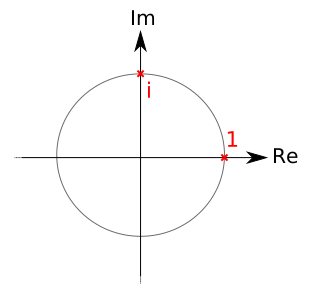
Follow it round the picture.
- Start at 1.
- Multiply by i, which turns everything a quarter turn. You are at i, straight up.
- Multiply by i again. Another quarter turn. You are at -1, on the left. So i \times i = -1, as we wanted.
- Multiply by i again. You are at -i, straight down.
- Multiply by i once more. You are back at 1.
Four quarter turns make a full circle. That is why the powers of i go round in a cycle of four: i, -1, -i, 1, and then again.
There is a second answer. You could also turn a quarter of the way the other way, clockwise. Two clockwise quarter turns also make a half turn. That number is -i, straight down. So -1 has two square roots, i and -i. That is just like 4, which has two square roots, 2 and -2.
The flat plane of numbers
Once you allow the "up" direction, you get a whole flat sheet of numbers. A point three steps across and two steps up is the number 3 + 2i. Numbers like this are called complex numbers. The word "complex" here does not mean "complicated". It means "made of two parts", like a sports complex made of several buildings. The across part, 3, is called the real part. The up part, 2, is called the imaginary part.
So i is not a fiction. It is completely natural, once you stop thinking of numbers as living only on a line. Ordinary numbers can stretch and flip. Complex numbers can also turn. A world full of turning things needs numbers that can turn.
3. Why it took 250 years
If the picture is that simple, why did it take so long? Because for two and a half centuries, nobody drew it. People used \sqrt{-1} in their calculations, got correct answers, and still believed it was meaningless.
| Who | When | What they did |
|---|---|---|
| Cardano | 1545 | First wrote down \sqrt{-15}, then called it useless |
| Bombelli | 1572 | Wrote the rules for calculating with such numbers |
| René Descartes | 1637 | Called them "imaginary", meaning fake. The insult became the name |
| Leonhard Euler | 1748 | Found the formula of section 5, and used them freely |
| Euler | 1777 | Introduced the letter i for \sqrt{-1} |
| Caspar Wessel | 1797 | First drew them as points on a flat sheet. Nobody read it |
| Jean-Robert Argand | 1806 | Drew the same picture, in a booklet without his name |
| Carl Friedrich Gauss | 1831 | Published the picture, and everyone finally accepted it |
| William Rowan Hamilton | 1833 | Showed they are just pairs of ordinary numbers |
Caspar Wessel was a Norwegian-born surveyor working in Denmark. A surveyor measures land and makes maps. Maps are all about directions on a flat sheet. So Wessel saw what the mathematicians had missed: a number with a direction is just a point on a flat sheet. He presented his paper to the Danish Academy of Sciences in 1797. But it was written in Danish, which few mathematicians read, and it sat unnoticed for a hundred years.
Jean-Robert Argand was a bookkeeper in Paris. He paid to print a small booklet of his idea in 1806 and did not even put his name on it. He was only credited years later. That is why the flat sheet of complex numbers is now called the Argand diagram.

Carl Friedrich Gauss had probably understood the picture since about 1799, and used it quietly in his own work. He only published it clearly in 1831. He also gave the name "complex number". And he made a wise remark. If +1, -1 and \sqrt{-1} had been called the "direct", "inverse" and "lateral" units, instead of positive, negative and imaginary, nobody would ever have found them mysterious. "Lateral" means "sideways". He was right. The problem was never the mathematics. It was the name.
William Rowan Hamilton, an Irish mathematician, removed the last doubt in 1833. He said a complex number like 3 + 2i is simply a pair of ordinary numbers, (3, 2): how far across, and how far up. He then gave a rule for multiplying two pairs.
Here is where his rule comes from. Multiply (a + bi) by (c + di) in the ordinary way, each part by each part:
(a + bi)(c + di) = ac + adi + bci + bd\,i^2
Now i^2 = -1, so the last piece is -bd. Gather the parts without i together, and the parts with i together:
= (ac - bd) + (ad + bc)\,i
So, written as pairs, Hamilton's rule is:
(a, b) \times (c, d) = (ac - bd,\; ad + bc)
This rule uses only ordinary numbers. Nothing in it is imaginary. Now try it on the pair (0, 1), which is i (zero across, one up):
(0, 1) \times (0, 1) = (0 \times 0 - 1 \times 1,\; 0 \times 1 + 1 \times 0) = (-1,\; 0)
The pair (-1, 0) means one step to the left and nothing up. That is just the ordinary number -1. So "a number whose square is -1" turns out to be nothing more than a pair of ordinary numbers, multiplied by a sensible rule.
4. Two tools we need: sine and cosine, and length
Before we can join i to e and π, we need two simple tools. Both come from drawing on the flat sheet.
Length, from Pythagoras
How far is the point 3 + 4i from 0? It is 3 across and 4 up. Draw the straight line from 0 to it. That line is the long side of a right-angled triangle whose short sides are 3 and 4. By Pythagoras (Chapter 3.2), the long side squared is 3^2 + 4^2 = 9 + 16 = 25. So the distance is \sqrt{25} = 5.
In general, the distance from 0 to the point a + bi is:
\sqrt{a^2 + b^2}
This distance is called the length of the complex number. It is written with straight lines on either side, like |a + bi|.
Points on a circle: cosine and sine
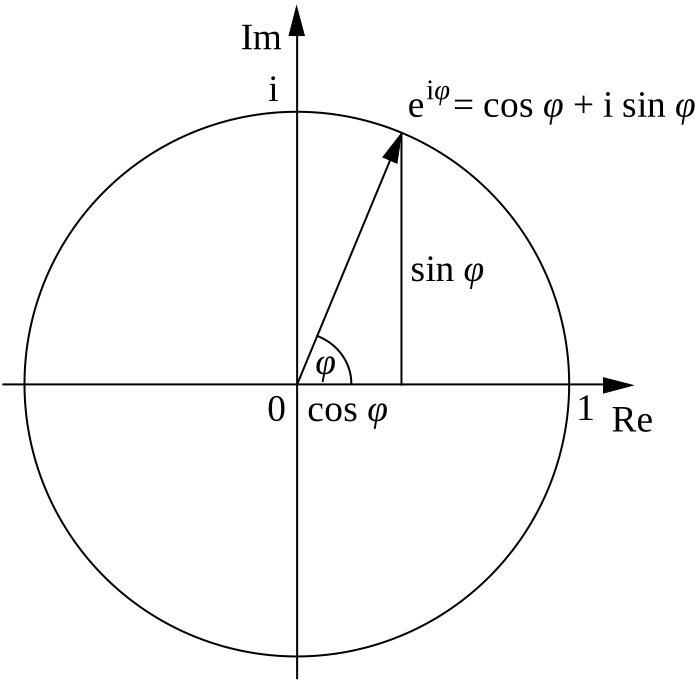
Draw a circle of radius 1 around the point 0. Start at the point 1, on the right. Now walk round the circle, anticlockwise, through some angle. Call the angle \theta, the Greek letter "theta".
Where have you ended up? Your position has an across part and an up part. They have names (Chapter 3.5).
- The cosine of the angle, written \cos\theta, is how far across you are.
- The sine of the angle, written \sin\theta, is how far up you are.
Some examples:
- Angle 0: you have not moved. You are at 1 across, 0 up. So \cos 0 = 1 and \sin 0 = 0.
- A quarter turn: you are straight up, at 0 across, 1 up. So the cosine is 0 and the sine is 1.
- A half turn: you are on the left, at -1 across, 0 up. So the cosine is -1 and the sine is 0.
So the point you reach, written as a complex number, is \cos\theta + i\sin\theta. The across part is the cosine, and the up part is the sine.
We will measure angles in radians (Chapter 3.3). An angle in radians is the distance you walk along a circle of radius 1. A full circle of radius 1 is 2\pi around, so a full turn is 2\pi radians. A half turn is π radians. A quarter turn is \frac{\pi}{2} radians.
5. How i joins e and π
Here is the most famous formula in mathematics, found by Euler in 1748:
e^{i\theta} = \cos\theta + i\sin\theta
Read it aloud: "e to the power i theta equals cos theta plus i times sin theta". Chapter 5.8 gives one proof, using endless sums. Here is a second proof that uses only Bernoulli's compound interest from Chapter 11.8. It shows exactly why growing and turning are the same thing.
Growth in many tiny steps
In Chapter 11.8 we saw that e^x is what you get by growing in many tiny steps:
e^x = \lim_{n\to\infty}\left(1 + \frac{x}{n}\right)^n
Each tiny step multiplies what you have by 1 + \frac{x}{n}. In words: "keep what you have, and add a small piece, \frac{x}{n} of it". When x is an ordinary positive number, the small piece points the same way as what you have. So each step just makes you a little longer. That is growth.
Now make the steps sideways
Put i\theta in place of x. Each tiny step now multiplies by 1 + \frac{i\theta}{n}. In words: "keep what you have, and add a small piece of it, turned a quarter". (Multiplying by i turns by a quarter turn, as section 2 showed.)
So each tiny step pushes you sideways, at a right angle to the direction you are already pointing.
Think of a dog on a lead, with its owner standing still. Suppose the dog always runs at a right angle to the lead. It never gets closer to its owner and never gets further away. It just goes round and round, in a circle. Pushing a point always at a right angle to its own direction does exactly that. It turns the point, without making it any longer.
Checking that the length does not grow
Each step multiplies by 1 + \frac{i\theta}{n}. That is the point 1 across and \frac{\theta}{n} up. From section 4, its length is:
\sqrt{1^2 + \left(\frac{\theta}{n}\right)^2} = \sqrt{1 + \frac{\theta^2}{n^2}}
Multiplying by this makes you a tiny bit longer each step. But only by a very tiny bit, because \frac{\theta^2}{n^2} is the square of a small number. Take \theta = \pi and n = 100. Then \frac{\theta^2}{n^2} is about 0.001. Over 100 steps, the total stretch is about 1.05, only 5%. With n = 1{,}000{,}000, the total stretch is only about 1.000005. As n grows, the stretch shrinks away to nothing. In the limit, the length does not change at all.
Checking how far it turns
Each step pushes you sideways by \frac{\theta}{n} of your length, and your length is 1. A small sideways step of \frac{\theta}{n} on a circle of radius 1 carries you about \frac{\theta}{n} of the way along the circle. By the meaning of a radian, that turns you through about \frac{\theta}{n} radians. After n steps, you have turned through n \times \frac{\theta}{n} = \theta radians.
Putting it together
So e^{i\theta} is the point that is still distance 1 from 0, but turned round through the angle \theta. From section 4, that point is \cos\theta + i\sin\theta. That is Euler's formula.
Watching it happen with real numbers
Let us take \theta = \pi, a half turn, and see the steps close in. Here is the case of n = 2, worked out by hand. Each step multiplies by 1 + \frac{i\pi}{2} = 1 + 1.5708i. Two steps means squaring it:
(1 + 1.5708i)^2 = 1 + 2 \times 1.5708i + (1.5708i)^2
The last piece is 1.5708^2 \times i^2 = 2.4674 \times (-1) = -2.4674. So the answer is 1 - 2.4674 + 3.1416i = -1.4674 + 3.1416i.
Here are the results for more and more steps.
| Steps n | \left(1 + \frac{i\pi}{n}\right)^n | Its length |
|---|---|---|
| 1 | 1 + 3.142i | 3.30 |
| 2 | -1.467 + 3.142i | 3.47 |
| 4 | -2.321 + 1.204i | 2.61 |
| 16 | -1.352 + 0.053i | 1.35 |
| 100 | -1.051 + 0.001i | 1.05 |
| 1,000,000 | -1.000 + 0.000i | 1.00 |
With only a few steps, each sideways push is big, and the point spirals outwards. With more steps, the pushes are smaller and the path tightens into a perfect half circle. It lands exactly on -1:
e^{i\pi} = -1
What this means
This is the connection.
- e is what you get by growing in many tiny steps.
- i is a quarter turn.
- Put i into growth, and every step pushes sideways, so growth becomes turning.
- π is how far round a half circle is. Turn for a distance π, and you are halfway round, at -1.
Add 1 to both sides of e^{i\pi} = -1, and you get e^{i\pi} + 1 = 0. Chapter 11.1 tells how Euler found it, and why it is often called the most beautiful equation in mathematics. None of the three numbers was invented with the others in mind. They were found centuries apart: e for a bank, π for a wheel, and i for an equation. They fit together because growing and turning are two directions of the same motion.
6. Some lovely results
i to the power i is an ordinary number
What is i^i? It looks as though it must be doubly imaginary. It is not. It is an ordinary number, and Euler worked it out in 1746.
Step 1. Write i as a power of e. i is the point a quarter turn round the circle. A quarter turn is \frac{\pi}{2} radians. So by Euler's formula:
i = e^{i\pi/2}
Step 2. Raise both sides to the power i. Chapter 1.4 gives the rule for a power of a power: (e^a)^b = e^{a \times b}. So:
i^i = \left(e^{i\pi/2}\right)^i = e^{i \times i \times \pi/2}
Step 3. Simplify. i \times i = -1. So the power becomes -\frac{\pi}{2}:
i^i = e^{-\pi/2} \approx 0.2079
So i^i is about 0.2079, an ordinary number between 0 and 1.
There is one honest footnote. Turning a quarter turn and then one extra full turn lands on the same point i. So i also equals e^{i(\pi/2 + 2\pi)}, and so on. Each of these gives a different value for i^i. For example, the next one is e^{-5\pi/2} \approx 0.00039. The value 0.2079 is the main one, from the smallest turn.
The square root of i
What number, multiplied by itself, gives i? With the turning picture, the answer is immediate.
- i is a quarter turn, which is 90°.
- Half of a quarter turn is an eighth of a turn, which is 45°.
- So \sqrt{i} is the point on the circle at 45°. Doing a 45° turn twice gives 90°, which is i.
The point at 45° is \cos 45° + i\sin 45°. In Chapter 11.6 we saw that both of these are \frac{1}{\sqrt2}, because a 45° angle is the diagonal of a square. So:
\sqrt{i} = \frac{1}{\sqrt2} + \frac{1}{\sqrt2}\,i = \frac{1 + i}{\sqrt2}
Check by multiplying it by itself. The bottom becomes \sqrt2 \times \sqrt2 = 2. The top becomes (1 + i)(1 + i) = 1 + i + i + i^2 = 1 + 2i - 1 = 2i. So the answer is \frac{2i}{2} = i. It works. And notice \sqrt2 appearing, all the way from Chapter 11.6.
The search for new numbers stops here
To find \sqrt{i}, we did not need any new kind of number. The complex numbers already had it. This is true in general. Chapter 2.2 states it: every equation built from powers of x has all of its answers among the complex numbers.
Look back at the whole journey. Counting numbers could not answer "3 take away 5", so we invented negative numbers. Those could not answer "3 divided by 5", so we invented fractions. Fractions could not answer "the square root of 2", so we needed irrational numbers. Those could not answer "the square root of -1", so we needed i. After i, the chain is finished. No equation of that kind needs anything more.
How Euler's formula proved π transcendental
In Chapter 11.7 we met the transcendental number. It is a number that is not the answer to any equation built from whole numbers. That chapter also said that Ferdinand von Lindemann proved π is transcendental in 1882. Now we can see the idea behind his proof.
- Lindemann proved a general rule. If you raise e to a power that is not zero, and that power is the answer to some equation built from whole numbers, then the result is never the answer to such an equation.
- Now look at e^{i\pi} = -1. The result, -1, certainly is the answer to such an equation: x + 1 = 0.
- So, by the rule, the power i\pi cannot be the answer to such an equation.
- But i is the answer to one (x^2 + 1 = 0). If π were too, then i \times \pi would also be. (Products of such numbers are always such numbers.) That would break step 3.
- So π is not the answer to any such equation. π is transcendental.
The hard part, which takes several pages of careful estimates, is proving the general rule in step 1. Euler's formula is what lets it reach π.
7. Why physics cannot do without i
For two centuries after Cardano, i was a tool for reaching real answers faster. In the 20th century, it turned out that nature itself seems to use it.
The electricity in your home
The electricity from your wall socket swings back and forth, 50 times a second, in a smooth wave. With a simple heater, the current (the flow of electricity) and the voltage (the push) swing together, in step.
Other parts behave differently. A capacitor is a part that stores electric charge, like a tiny rechargeable tank. In a capacitor, the current reaches its peak a quarter of a swing before the voltage does. In a coil of wire, the current reaches its peak a quarter of a swing after.
A quarter of a swing is a quarter of a turn of the hidden circle behind the wave. So in 1893 the American engineer Charles Steinmetz had a simple, powerful idea. He drew each swing as a turning arrow, e^{i\omega t}, where \omega (the Greek letter omega) says how fast it turns. Then a capacitor's quarter-swing head start is just multiplication by i. All the hard calculations with waves became ordinary multiplication. Engineers write j instead of i, because they already use i for current. Every power grid in the world is designed this way. Volume III, Part 1 teaches it.
Waves and signals
Every wave can be drawn as the shadow of a turning arrow, using Euler's formula. Part 9 of this volume builds the whole of Fourier analysis on this: the way to split any sound or signal into simple waves. It is how your phone works out the notes in a song, and how noise-cancelling headphones find the noise to cancel.
Atoms and light
In quantum mechanics, the science of atoms and light (Volume IV, Part 7), the main equation is called the Schrödinger equation. It has an i written right into it.
Here is the idea, in plain words. Quantum mechanics describes each possible thing a particle might do with an arrow, called an amplitude. The chance of the particle actually doing it is the length of the arrow, squared. When a particle has two possible paths, you add their two arrows together, tip to tail.
Now here is why the arrows must be able to turn. If two arrows point in opposite directions, they cancel out, and the total is zero. Then the particle never arrives there at all. That cancelling is real. In experiments, light shone through two narrow slits makes dark stripes on a screen, exactly where the two paths cancel. Ordinary chances cannot do this, because they are always positive and can only add up. Arrows that can point any way round can cancel. And arrows that point any way round are complex numbers.
For a long time, physicists wondered whether i was just a convenience here, as it is in circuit design. Perhaps quantum mechanics could be rewritten using only ordinary numbers. In 2021 a group of physicists showed that such a rewritten theory would predict different results in a certain experiment. In 2022 two separate teams carried out versions of that experiment. The results agreed with the complex-number version. As far as anyone can tell, nature really does use i.
8. Where i shows up in your life
The wires to your home. The whole power grid is designed using complex numbers. The "power factor" printed on large appliances and motors is the cosine of an angle on the Argand diagram: the angle between the turning arrows of current and voltage.
Your Wi-Fi and mobile data. A phone signal is sent as two waves at once, a quarter of a swing apart. Engineers call them the I part and the Q part, meaning "in step" and "a quarter turn out of step". Together they make one complex number. Each short burst of radio carries one point on the Argand diagram. The more different points the phone can tell apart, the more information fits into each burst.
An MRI scan. The scanner measures complex numbers, not a picture. A computer turns them into the image you see using the Fourier analysis of Part 9, which is built on e^{i\theta}.
Your music. The equaliser, noise cancelling and file compression in a music app all split the sound into turning arrows of different speeds, using e^{i\theta}.
\sqrt2, π, e and i each answered a question. The next number answers a question about shape and growth together. It is the most over-praised number in mathematics, and its true story is better than the myths about it. Next: 11.10 — The Golden Ratio.