Appearance
11.6 — √2: The Number That Broke the Fractions
In a museum at Yale University in America there is a small round clay tablet, about the size of the palm of your hand. Its catalogue number is YBC 7289. The letters stand for "Yale Babylonian Collection", and 7289 is simply its number in the museum's list.
A student in ancient Mesopotamia, the land that is now Iraq, scratched it into wet clay somewhere between 1800 and 1600 BCE. That is more than a thousand years before the Greek thinker Pythagoras was born.
The student drew a square on it. Then the student drew both of its diagonals. A diagonal is a straight line from one corner of a square to the opposite corner. Along one diagonal, the student wrote a number.
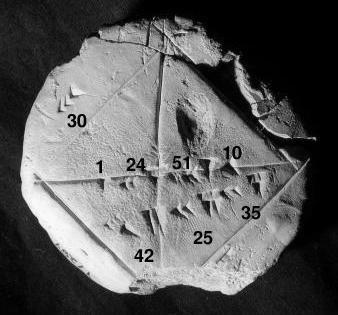
To read that number, we first need to understand how the Babylonians wrote numbers. It is different from our way, but you already use their way every day without noticing.
1. How to read a Babylonian number
First, how our own numbers work
Look at how we write the number 0.4. The 4 sits in the first place after the decimal point. That place is worth tenths. So 0.4 means "4 tenths", which is \frac{4}{10}.
Now look at 0.04. The 4 has moved one place further right. That place is worth hundredths. So 0.04 means "4 hundredths", which is \frac{4}{100}.
Every time you move one place to the right, each place is worth one tenth of the place before it. Tenths, then hundredths, then thousandths. The pieces get smaller and smaller.
We split things into 10 parts because we count in tens. People probably started that because we have ten fingers.
The Babylonians split things into 60 parts
The Babylonians counted in sixties. So each place after their "point" was worth one sixtieth of the place before it, not one tenth.
That sounds strange, but you already do it with time.
- One hour is split into 60 minutes. So one minute is \frac{1}{60} of an hour.
- One minute is split into 60 seconds. So one second is \frac{1}{60} of a minute.
- How big is one second compared with a whole hour? It is a sixtieth of a sixtieth. That is \frac{1}{60} \times \frac{1}{60} = \frac{1}{3600} of an hour. There are 3,600 seconds in an hour.
Our habit of 60 minutes and 60 seconds actually comes from the Babylonians. They handed it down to the Greeks, and the Greeks handed it to us.
Now read the tablet
The number on the diagonal is written in four groups. In our digits they are: 1, then 24, then 51, then 10.
Read it as if it were a length of time.
- 1 is one whole. Think of it as 1 hour.
- 24 is in the first place after the point. That place is worth sixtieths. Think of it as 24 minutes.
- 51 is in the second place. That place is worth sixtieths of sixtieths. Think of it as 51 seconds.
- 10 is in the third place. That place is a sixtieth of a second. Think of it as 10 tiny pieces, each one sixtieth of a second.
So the number is like "1 hour, 24 minutes, 51 seconds, and 10 sixtieths of a second". We want to know how much that is, as a number of hours.
Why do we divide, and not multiply? Because each piece is smaller than a whole hour. 24 minutes is less than an hour. To find what fraction of an hour it is, you divide by the number of minutes in an hour. In the same way, 51 seconds is a small fraction of an hour, so you divide by the number of seconds in an hour.
Here is each piece, worked out.
The 24. 24 minutes, out of 60 minutes in an hour:
\frac{24}{60} = 0.4
Check it: 0.4 of an hour is 0.4 \times 60 = 24 minutes. Correct.
The 51. 51 seconds, out of 3,600 seconds in an hour. Remember that 3,600 is 60 \times 60. Mathematicians write 60 \times 60 more briefly as 60^2, read "sixty squared". The small raised 2 just means "multiply 60 by itself":
\frac{51}{60^2} = \frac{51}{3600} = 0.0141666\ldots
The 10. Each of these tiny pieces is a sixtieth of a second. So one hour holds 60 \times 60 \times 60 = 216{,}000 of them. We write 60 \times 60 \times 60 as 60^3, read "sixty cubed", meaning "60 multiplied by itself three times":
\frac{10}{60^3} = \frac{10}{216000} = 0.0000462\ldots
So the powers 60^2 and 60^3 are there for one reason. Each place to the right is sixty times smaller than the place before it. Two places to the right is 60 \times 60 times smaller. Three places is 60 \times 60 \times 60 times smaller.
Now add everything up:
1 + 0.4 + 0.0141666 + 0.0000462 = 1.4142129\ldots
Written in one line, the whole calculation is:
1 + \frac{24}{60} + \frac{51}{60^2} + \frac{10}{60^3} = 1.4142129\ldots
You can now read that line easily. It says: "one whole, plus 24 sixtieths, plus 51 pieces of size one-sixtieth-of-a-sixtieth, plus 10 pieces even smaller than that".
What the number is
The number the student wrote is the length of the diagonal of a square whose sides are 1 long. Today we write that number as \sqrt2. Section 2 explains what that sign means and why the diagonal has that length.
The true value of \sqrt2 is 1.4142135\ldots. The student wrote 1.4142129\ldots. The difference is 0.0000006, which is less than one part in two million. If the square's side were a kilometre long, the student's diagonal would be wrong by about half a millimetre.
So people knew this number extremely well, nearly 4,000 years ago. What they did not know was that it hid a shock. We will get to the shock in section 4.
2. What √2 means, and why it has to exist
The question
Imagine a builder. She has a square floor tile whose sides are each 1 metre long. Its area is 1 \times 1 = 1 square metre. She wants a square tile with exactly twice that area, 2 square metres. How long must its side be?
The area of a square is its side multiplied by itself. So she needs a side length which, multiplied by itself, gives 2.
- Try 1: 1 \times 1 = 1. Too small.
- Try 2: 2 \times 2 = 4. Too big.
So the answer is somewhere between 1 and 2. We give it a name before we know its value. We call it \sqrt2, read "the square root of two".
The sign \sqrt{\ } means "the number which, multiplied by itself, gives the number under the sign." So \sqrt9 = 3, because 3 \times 3 = 9. In the same way, \sqrt2 is the number which, multiplied by itself, gives 2. Multiplying a number by itself is called squaring it, which is why this is called a square root.
Drawing the answer without any calculation
Here is a lovely way to draw a square of area 2. The Greek philosopher Plato wrote it down around 385 BCE, in a conversation called the Meno. In it, his teacher Socrates shows it to a boy who has never studied geometry.
Here is how to read the figure, step by step.
- On the left is a square with sides of length 1. Its area is 1.
- Draw its diagonal. The diagonal cuts the square into two triangles that are exactly the same. So each triangle has half the area: \frac12.
- On the right, we build a new square. Each of its four sides is a diagonal of a small square like the one on the left. It looks tilted, like a diamond, but it is a perfect square.
- Look inside the new square. It is made of exactly four of those half-triangles, coloured differently so you can count them.
- Four halves make 2. So the new square has area 2.
That is exactly the tile the builder wanted. Its side is the diagonal of the small square. So the diagonal of a square with side 1 has length \sqrt2.
You may know the same fact from Pythagoras' theorem (Chapter 3.2). That theorem says that in a triangle with a right angle, the two short sides squared and added together give the long side squared. Here the two short sides are 1 and 1, so the long side squared is 1 + 1 = 2. So the long side is \sqrt2. The four-triangle picture is just Pythagoras' theorem for this one special case, drawn so that you can see it.
Why this matters
The length \sqrt2 is not an idea someone made up. It is a real length. You can draw it with a pencil. In every square, however big, the diagonal is exactly \sqrt2 times as long as a side. So the number has to exist. The only question is what kind of number it turns out to be.
3. Finding its value, three ways
We know \sqrt2 is between 1 and 2. Here are three ways to pin it down more exactly. Each one is cleverer than the last.
Method 1: guess and check, one digit at a time
The simplest way is to guess and check. Take a guess, multiply it by itself, and see whether you get more or less than 2.
Try guesses with one decimal place:
| Guess | Guess × guess | Compared with 2 |
|---|---|---|
| 1.3 | 1.69 | too small |
| 1.4 | 1.96 | too small |
| 1.5 | 2.25 | too big |
So \sqrt2 is between 1.4 and 1.5. Now try guesses inside that gap, with two decimal places:
| Guess | Guess × guess | Compared with 2 |
|---|---|---|
| 1.41 | 1.9881 | too small |
| 1.42 | 2.0164 | too big |
So \sqrt2 is between 1.41 and 1.42. You can keep going. Each round gives you one more correct digit.
This always works. But it is slow. Ten rounds of long multiplication give you only ten digits.
Method 2: the Babylonian averaging trick
There is a much faster way. It is built on one simple observation, so let us go through the observation slowly.
The observation. Suppose you guess 1.5. Now divide 2 by your guess: 2 \div 1.5 = 1.333\ldots Look at the two numbers, 1.5 and 1.333. Multiply them together, and you get exactly 2. That is no accident. Dividing 2 by a number and then multiplying back by that number always gives 2 again.
Now think about it.
- Your guess 1.5 is too big, because 1.5 \times 1.5 = 2.25, which is more than 2.
- So the partner number, 1.333, must be too small. If both were too big, their product would be more than 2. If both were too small, their product would be less than 2. To multiply to exactly 2, one has to be too big and the other too small.
- So the true \sqrt2 is somewhere between the two.
The trick. If the answer is between two numbers, a good next guess is the point exactly halfway between them. The halfway point between two numbers is their average: add them and divide by 2.
So the rule is:
New guess = the average of (your guess) and (2 divided by your guess).
Let us run it from a first guess of 1, and spell out every bit of arithmetic.
Round 1. The guess is 1.
- 2 divided by 1 is 2.
- The average of 1 and 2: (1 + 2) \div 2 = 3 \div 2 = 1.5.
- New guess: 1.5.
Round 2. The guess is 1.5, which as a fraction is \frac32.
- 2 divided by \frac32. To divide by a fraction, you flip it upside down and multiply. Flipping \frac32 gives \frac23. So 2 \div \frac32 = 2 \times \frac23 = \frac43, which is 1.333...
- Now average \frac32 and \frac43. To add two fractions, first give them the same bottom number. The smallest number that both 2 and 3 divide into is 6. So \frac32 = \frac96 and \frac43 = \frac86.
- Add: \frac96 + \frac86 = \frac{17}{6}.
- Divide by 2, which doubles the bottom: \frac{17}{12}.
- New guess: \frac{17}{12}, which is 1.41666...
Round 3. The guess is \frac{17}{12}.
- 2 divided by \frac{17}{12}: flip and multiply. 2 \times \frac{12}{17} = \frac{24}{17}.
- Average \frac{17}{12} and \frac{24}{17}. The common bottom is 12 \times 17 = 204. So \frac{17}{12} = \frac{17 \times 17}{204} = \frac{289}{204}, and \frac{24}{17} = \frac{24 \times 12}{204} = \frac{288}{204}.
- Add: \frac{289 + 288}{204} = \frac{577}{204}.
- Divide by 2: \frac{577}{408}.
- New guess: \frac{577}{408}, which is 1.4142156...
The true value is 1.4142135... Compare the guesses with it:
| Round | Guess | Correct digits |
|---|---|---|
| 1 | 1.5 | 1 (just the "1") |
| 2 | 1.41666 | 3 ("1.41") |
| 3 | 1.4142156 | 6 ("1.41421") |
The number of correct digits roughly doubles every round. Three rounds of easy fractions beat many rounds of guess-and-check.
Why the digits double
This part uses a little algebra. Algebra just means using a letter to stand for a number we have not fixed yet (Chapter 2.1). Let x stand for your current guess, whatever it is.
The rule says the new guess is the average of x and \frac2x:
\text{new guess} = \frac{x + \frac2x}{2} = \frac{x}{2} + \frac{1}{x}
The second step just splits the average into two halves: half of x, and half of \frac2x, which is \frac1x.
Now we ask: how far is the new guess from the true answer \sqrt2? Subtract:
\text{new error} = \frac{x}{2} + \frac{1}{x} - \sqrt2
These three pieces have different bottoms. Put them all over the same bottom, 2x. To do that, multiply the top and bottom of each piece by whatever is missing:
- \frac{x}{2} becomes \frac{x \cdot x}{2x} = \frac{x^2}{2x}
- \frac1x becomes \frac{2}{2x}
- \sqrt2 becomes \frac{2\sqrt2\,x}{2x}
So:
\text{new error} = \frac{x^2 + 2 - 2\sqrt2\,x}{2x}
Now look closely at the top, x^2 - 2\sqrt2\,x + 2. It is what you get when you multiply (x - \sqrt2) by itself. Check by multiplying out the brackets, each part by each part:
(x - \sqrt2)(x - \sqrt2) = x \cdot x - x\sqrt2 - \sqrt2\,x + \sqrt2 \cdot \sqrt2 = x^2 - 2\sqrt2\,x + 2
The last piece is 2 because \sqrt2 \times \sqrt2 = 2. That is what \sqrt2 means. So:
\text{new error} = \frac{(x - \sqrt2)^2}{2x}
Now read this in words. The bracket x - \sqrt2 is the old error: how far the old guess was from the truth. So the new error is the old error multiplied by itself, then divided by 2x. Since x is about 1.4, 2x is about 2.8, roughly 3.
Here is why that is so powerful. Suppose the old guess was wrong by 0.01.
- Multiply 0.01 by itself: 0.01 \times 0.01 = 0.0001.
- Divide by about 3: about 0.00003.
An error of 0.01 has 2 zeros after the point. An error of 0.00003 has 4. Squaring a small number doubles its zeros. That is why the correct digits double.
We do not know for certain how the student who made YBC 7289 found the value. Averaging of this kind is the leading guess among historians. Three and a half thousand years later, Isaac Newton found a general method for solving equations. For the equation "a number times itself equals 2", his method gives exactly this averaging rule. Chapter 10.2 tells that story. Many computer chips still use the rule today to take square roots.
Method 3: the ladder of fractions
The Greeks found a third route. The writer Theon of Smyrna described it around 100 CE. It produces fractions that get closer and closer to \sqrt2, using only whole numbers.
The rule. Start with the fraction \frac11. To get the next fraction from a fraction \frac{a}{b}:
- the new top is top + 2 × bottom, which is a + 2b;
- the new bottom is top + bottom, which is a + b.
Run it. Start from \frac11, so the top is 1 and the bottom is 1.
- New top: 1 + 2 \times 1 = 3. New bottom: 1 + 1 = 2. Next fraction: \frac32.
- From \frac32: new top 3 + 2 \times 2 = 7, new bottom 3 + 2 = 5. Next: \frac75.
- From \frac75: new top 7 + 10 = 17, new bottom 7 + 5 = 12. Next: \frac{17}{12}.
- From \frac{17}{12}: new top 17 + 24 = 41, new bottom 17 + 12 = 29. Next: \frac{41}{29}.
Here are the first seven, as decimals:
| Step | Fraction | As a decimal |
|---|---|---|
| 1 | \frac11 | 1 |
| 2 | \frac32 | 1.5 |
| 3 | \frac75 | 1.4 |
| 4 | \frac{17}{12} | 1.41667 |
| 5 | \frac{41}{29} | 1.41379 |
| 6 | \frac{99}{70} | 1.41429 |
| 7 | \frac{239}{169} | 1.41420 |
The decimals swing above and below 1.41421, getting closer every time.
Why the rule works
First, where does the rule come from? Write a guess as r = \frac{a}{b}. The rule turns it into \frac{a + 2b}{a + b}. Divide the top and bottom by b, which does not change a fraction's value. That gives \frac{r + 2}{r + 1}. So the rule is really: new guess = (guess + 2) ÷ (guess + 1).
Now try putting in the true answer, r = \sqrt2. Then the new guess is \frac{\sqrt2 + 2}{\sqrt2 + 1}. Is that also \sqrt2? Multiply \sqrt2 by the bottom, \sqrt2 + 1:
\sqrt2 \times (\sqrt2 + 1) = \sqrt2 \times \sqrt2 + \sqrt2 = 2 + \sqrt2
That is exactly the top. So \frac{\sqrt2 + 2}{\sqrt2 + 1} = \sqrt2. The rule leaves \sqrt2 exactly where it is. It pulls every other guess towards it.
A way to measure how close each fraction is
If a fraction \frac{a}{b} were exactly \sqrt2, then \frac{a}{b} \times \frac{a}{b} would be exactly 2. That means a \times a would be exactly 2 \times b \times b. In short, a^2 = 2b^2. So a good way to see how close a fraction is, is to work out a^2 - 2b^2. If that were 0, the fraction would be perfect.
Work it out for each fraction on the ladder:
| Fraction | a^2 | 2b^2 | a^2 - 2b^2 |
|---|---|---|---|
| \frac11 | 1 | 2 | −1 |
| \frac32 | 9 | 8 | +1 |
| \frac75 | 49 | 50 | −1 |
| \frac{17}{12} | 289 | 288 | +1 |
| \frac{41}{29} | 1681 | 1682 | −1 |
| \frac{99}{70} | 9801 | 9800 | +1 |
It is never 0. But it is always just +1 or -1. It never gets bigger.
That is exactly what we want. Since a^2 = 2b^2 \pm 1, divide both sides by b^2:
\frac{a^2}{b^2} = 2 \pm \frac{1}{b^2}
So the fraction, squared, misses 2 by exactly \frac{1}{b^2}. The bottom number b gets bigger at every step. For \frac{99}{70}, b^2 = 4900, so it misses by only \frac{1}{4900}. The fractions creep closer and closer.
Why the difference is always +1 or −1
Here is the algebra that guarantees it. Take any fraction \frac{a}{b} on the ladder. The next one has top a + 2b and bottom a + b. Work out the same measurement, "top squared minus twice bottom squared", for the new fraction:
(a + 2b)^2 - 2(a + b)^2
Multiply out each bracket. A bracket squared is the bracket times itself.
- (a + 2b)^2 = a^2 + 4ab + 4b^2
- (a + b)^2 = a^2 + 2ab + b^2, so twice it is 2a^2 + 4ab + 2b^2
Subtract the second from the first:
(a^2 + 4ab + 4b^2) - (2a^2 + 4ab + 2b^2) = -a^2 + 2b^2
The 4ab parts cancel exactly. What is left, -a^2 + 2b^2, is the old measurement a^2 - 2b^2 with its sign flipped.
So if the old fraction gave -1, the new one gives +1. The next gives -1 again. The size always stays 1. Nothing was arranged to make this happen. The algebra forces it.
The Greeks called these pairs of numbers side and diagonal numbers. That is because b behaves like the side of a square and a like its diagonal. An equation asking for whole numbers with a^2 - 2b^2 = \pm1 is now called a Pell equation.
The tower that never ends
There is one more way to write \sqrt2, and it shows something important about it.
Step 1. Multiply (\sqrt2 - 1) by (\sqrt2 + 1). Each part times each part:
(\sqrt2 - 1)(\sqrt2 + 1) = \sqrt2 \cdot \sqrt2 + \sqrt2 - \sqrt2 - 1 = 2 - 1 = 1
The two middle pieces cancel.
Step 2. If two things multiply to 1, each is 1 divided by the other. So:
\sqrt2 - 1 = \frac{1}{\sqrt2 + 1}
Step 3. The bottom, \sqrt2 + 1, can be written as 2 + (\sqrt2 - 1). Both are the same number, because 2 - 1 = 1. So:
\sqrt2 - 1 = \frac{1}{2 + (\sqrt2 - 1)}
Step 4. Look at the bottom. The thing we started with, \sqrt2 - 1, has appeared again. So we can replace it with its own formula from step 3. Then it appears again, and we replace it again, forever. Adding 1 to both sides at the end gives:
\sqrt2 = 1 + \cfrac{1}{2 + \cfrac{1}{2 + \cfrac{1}{2 + \cdots}}}
A tower like this is called a continued fraction. Cut it off after one, two or three floors and work out the value. You get \frac32, \frac75, \frac{17}{12}. That is the ladder again.
Why this matters. Build the same kind of tower for an ordinary fraction, such as \frac{17}{12}:
- \frac{17}{12} = 1 + \frac{5}{12}. Flip the leftover: \frac{5}{12} = \frac{1}{12/5}, and \frac{12}{5} = 2 + \frac25.
- Flip again: \frac25 = \frac{1}{5/2}, and \frac52 = 2 + \frac12.
- The leftover is \frac12, which is already "1 over a whole number". The tower stops.
So \frac{17}{12} = 1 + \cfrac{1}{2 + \cfrac{1}{2 + \cfrac{1}{2}}}, three floors, and finished.
A fraction's tower always stops. Each flip leaves a remainder with a smaller bottom number, and whole numbers cannot keep getting smaller forever. The tower for \sqrt2 never stops. That is a strong hint that \sqrt2 is not a fraction at all. The next section proves it.
4. The shock: √2 can never be a fraction
A fraction here means one whole number divided by another, like \frac75 or \frac{17}{12}. A number that can be written this way is called rational, from the word ratio. The ladder gives fractions that come very close to \sqrt2. The question is whether some fraction could hit it exactly.
The answer is no. In Chapter 1.7 we proved this using even and odd numbers. Here are two more proofs. Each one shows the truth from a different side.
Before the proofs: fractions "in lowest terms"
Many fractions can be simplified. \frac64 is the same as \frac32, because you can divide the top and bottom both by 2. When you cannot divide the top and bottom by the same number any more, the fraction is in lowest terms. Every fraction can be simplified until it is in lowest terms.
Both proofs work the same way. They assume \sqrt2 is a fraction in lowest terms, and then show that this assumption leads to something impossible. If an assumption leads to something impossible, the assumption must be false. This way of proving things is called proof by contradiction.
Proof 1: using only last digits
Step 1. Assume it. Suppose \sqrt2 = \frac{a}{b}, where a and b are whole numbers, and the fraction is in lowest terms.
Step 2. Remove the square root. Multiply each side by itself. The left side becomes \sqrt2 \times \sqrt2 = 2. The right side becomes \frac{a}{b} \times \frac{a}{b} = \frac{a \times a}{b \times b}. So:
2 = \frac{a^2}{b^2}
Now multiply both sides by b^2 to clear the bottom:
2b^2 = a^2
This is a statement about whole numbers only: "twice b squared equals a squared."
Step 3. Look at last digits of squares. The last digit of a square depends only on the last digit of the number you squared. For example, 23 and 13 both end in 3, and 23^2 = 529 and 13^2 = 169 both end in 9. So we only need to check the ten possible last digits:
| Last digit of the number | 0 | 1 | 2 | 3 | 4 | 5 | 6 | 7 | 8 | 9 |
|---|---|---|---|---|---|---|---|---|---|---|
| Last digit of its square | 0 | 1 | 4 | 9 | 6 | 5 | 6 | 9 | 4 | 1 |
So a square always ends in 0, 1, 4, 5, 6 or 9. It never ends in 2, 3, 7 or 8.
Step 4. Look at last digits of twice a square. Take each possible last digit of a square and double it. Keep only the last digit of the answer.
- 0 doubled is 0
- 1 doubled is 2
- 4 doubled is 8
- 5 doubled is 10, which ends in 0
- 6 doubled is 12, which ends in 2
- 9 doubled is 18, which ends in 8
So twice a square always ends in 0, 2 or 8.
Step 5. Compare. From step 2, a^2 and 2b^2 are the same number. So they end in the same digit. a^2 must end in one of 0, 1, 4, 5, 6, 9. 2b^2 must end in one of 0, 2, 8. The only digit on both lists is 0.
Step 6. What that forces.
- a^2 ends in 0. From the table, only numbers ending in 0 have squares ending in 0. So a ends in 0.
- 2b^2 ends in 0. From step 4, that happens when b^2 ends in 0 or 5. From the table, that happens when b ends in 0 or 5.
A number ending in 0 or 5 can be divided by 5. So a and b can both be divided by 5.
Step 7. The contradiction. But we said the fraction was in lowest terms. That means a and b cannot both be divided by the same number. Yet we have just shown they can. The assumption has broken itself. So \sqrt2 is not a fraction.
Proof 2: a proof by picture
The American mathematician Stanley Tennenbaum found this one in the 1950s. It needs almost no numbers.
Step 1. Assume it, and pick the smallest. Suppose \sqrt2 = \frac{a}{b} with whole numbers. Then, exactly as in proof 1, a^2 = 2b^2. There might be many pairs of whole numbers that do this. Among all such pairs, pick the one with the smallest a. There must be a smallest, because whole numbers cannot go down forever. They stop at 1.
Step 2. Turn the equation into a picture. The area of a square is its side squared. So a^2 = 2b^2 says: one big square with side a has the same area as two middle-sized squares with side b.
Step 3. Put the two middle squares inside the big one. Place one in the bottom-left corner and one in the top-right corner. They are too big to fit side by side, so they overlap in the middle. And they leave two small corners of the big square uncovered.
Step 4. Covered twice equals missed. Think of the big square as a floor and the two coloured squares as two rugs. The two rugs together have exactly as much area as the floor. When you lay them down, the purple middle gets covered twice, and the two amber corners are not covered at all. For the total rug area to equal the floor area, the extra in the middle must make up exactly for what is missing at the corners. So: the purple area equals the two amber areas added together.
Step 5. Measure the pieces.
- The purple overlap is a square. Across the bottom, the blue rug covers a width b from the left. The green rug covers a width b from the right. Together they cover b + b = 2b, but the floor is only a wide. So they overlap by 2b - a. The purple square's side is 2b - a.
- Each amber gap is a square. The floor is a wide, and a rug covers b of it, so the uncovered strip is a - b wide. Each amber square's side is a - b.
So step 4 becomes:
(2b - a)^2 = 2\,(a - b)^2
Step 6. The contradiction. Look at this new equation. It has exactly the same form as a^2 = 2b^2: "one square equals two copies of another square". But the numbers are new: 2b - a instead of a, and a - b instead of b. Both are whole numbers. And the picture shows that the purple square is smaller than the big square. So 2b - a is smaller than a.
But we chose a to be the smallest possible. Now we have found a smaller one. That is impossible. So no such whole numbers exist, and \sqrt2 is not a fraction.
This kind of argument has a name: infinite descent. If every solution would give you a smaller solution, then there can be no solution at all, because whole numbers cannot keep getting smaller forever.
What "irrational" means
A number that is not a fraction is called irrational. The word does not mean "unreasonable" or "crazy". It just means "not a ratio".
You can see it in the decimals too. In Chapter 1.3 we saw that every fraction's decimal either stops, like \frac14 = 0.25, or repeats the same block forever, like \frac13 = 0.333\ldots or \frac17 = 0.142857142857\ldots So an irrational number has decimals that go on forever and never fall into a repeating pattern. \sqrt2 = 1.41421356237\ldots is like that.
5. The story: the end of "all is number"
Around 530 BCE, the followers of Pythagoras lived together in a community in southern Italy. They believed something close to a religion: everything in the world can be described by whole numbers and their ratios.
They had good reasons. Music seemed to prove it. Pluck a string. Then pluck a string exactly half as long, and you hear the same note, only higher. That is an octave. A string two thirds as long gives another pleasing note. Beautiful sounds came from simple ratios of whole numbers.
Their belief meant something precise about lengths. They believed any two lengths were commensurable. That is a long word for a simple idea. It means you can always find some small unit of length that fits into both lengths a whole number of times.
Here is an example. Take a stick 1.5 m long and a stick 2.5 m long. A unit of 0.5 m fits exactly 3 times into the first and exactly 5 times into the second. So those two lengths are commensurable.
Now take the side and the diagonal of a square. Is there a tiny unit that fits a whole number of times into both? If there were, say it fitted b times into the side and a times into the diagonal. Then the diagonal divided by the side would be \frac{a}{b}, a fraction. But section 4 proved that this ratio is \sqrt2, which is not a fraction. So no unit, however tiny, fits both. The side and diagonal of a square are not commensurable.
The discovery is usually credited to a Pythagorean called Hippasus of Metapontum. A later legend says he was drowned at sea as a punishment for revealing it. Historians treat this as a story, not a fact. Some think the first irrational ratio was not \sqrt2 at all but the diagonal of a five-sided figure, which is the golden ratio of Chapter 11.10.
What the Greeks did next is the important part. They did not throw the discovery away.
- Plato reports that his teacher Theodorus of Cyrene proved that \sqrt3, \sqrt5, and so on up to \sqrt{17} are also not fractions (leaving out the perfect squares like \sqrt4 = 2).
- Around 370 BCE, Eudoxus of Cnidus found a way to compare any two lengths, even ones that share no unit. Euclid later wrote it down as Book V of his famous geometry book, the Elements.
Eudoxus's idea waited more than two thousand years. In 1872 the German mathematician Richard Dedekind used it to define the real numbers: all the numbers on the number line, including the ones like \sqrt2 that are not fractions. You can read in Chapter 1.7 why calculus needs every one of those numbers. So the crisis that \sqrt2 started in ancient Greece was only finally settled in the 1800s. That settlement is now the ground that all of calculus stands on.
6. Where √2 shows up in your life
Your A4 paper
The A sizes of paper follow one rule. Fold a sheet in half, and the half has exactly the same shape as the whole. It is smaller, but not fatter or thinner. Let us find out what shape that rule forces.
Call the long side of the sheet L and the short side S.
Step 1. Fold it. You fold across the long side, so the long side is cut in half. The half sheet now has a long side of S (the old short side) and a short side of \frac{L}{2} (half the old long side).
Step 2. "Same shape" means the same ratio. Two rectangles have the same shape when "long side divided by short side" is the same for both.
- Whole sheet: \frac{L}{S}
- Half sheet: \frac{S}{L/2}
So the rule says:
\frac{L}{S} = \frac{S}{L/2}
Step 3. Tidy up the right side. Dividing by \frac{L}{2} is the same as multiplying by \frac{2}{L} (flip and multiply). So the right side is S \times \frac{2}{L} = \frac{2S}{L}. Now:
\frac{L}{S} = \frac{2S}{L}
Step 4. Clear the bottoms. Multiply both sides by S, and then by L:
L \times L = 2 \times S \times S, \qquad\text{that is,}\qquad L^2 = 2S^2
Step 5. Take the ratio. Divide both sides by S^2: \frac{L^2}{S^2} = 2. So \frac{L}{S}, multiplied by itself, is 2. That means \frac{L}{S} = \sqrt2.
So every A-size sheet is \sqrt2 times as long as it is wide. The biggest size, A0, is chosen to have an area of exactly 1 square metre, which makes it 841 mm by 1189 mm. Check the ratio: 1189 \div 841 = 1.4138, which is \sqrt2 to three places. Fold A0 in half and you get A1. Fold again for A2, then A3, then A4, which is 210 mm by 297 mm. They all have the same shape. That is why a photocopier can shrink two A4 pages onto one A4 page with no white border left over.
The socket in your wall
In India, the electricity supply is labelled 230 volts. A volt measures how hard electricity is being pushed through a wire.
But the electricity in your house is alternating current. The push does not stay steady. It rises, falls, reverses, and comes back, 50 times every second. The shape of that swing is a smooth wave, called a sine wave (Chapter 3.5). At the very top of each swing, the push reaches about 325 volts. That is 230 \times \sqrt2.
So why does the label say 230 and not 325? Because the label tells you the useful strength, not the peak. Here is where the \sqrt2 comes from, step by step.
Step 1. Heat depends on the push multiplied by itself. Double the push on a heater and two things double at once. Twice as much electricity flows, and each bit of it is pushed twice as hard. So the heat goes up by 2 \times 2 = 4 times. Heat follows the push squared.
Step 2. Average the squared push over one swing. The push keeps changing, so we want its squared value on average. For a sine wave whose peak is V, the squared push at any moment is V^2 times the sine squared. Over a full swing, the sine squared averages to exactly \frac12.
Now we will see why it averages to a half. Sine has a partner wave called cosine. In Chapter 3.5 we saw a neat fact about this pair. At every moment, sine squared plus cosine squared equals exactly 1. The cosine wave is just the sine wave shifted along by a quarter of a swing, so over a whole swing the two waves go through exactly the same values, only at different times. So their squares have the same average. Two equal averages that add to 1 must each be \frac12.
So the average of the squared push is \frac{V^2}{2}.
Step 3. Find the steady push that heats just as well. A steady push U would heat the same heater by U^2. For it to match, U^2 = \frac{V^2}{2}. Take the square root of both sides: U = \frac{V}{\sqrt2}.
That steady equivalent is what the label calls "230 volts". So the peak is V = 230 \times \sqrt2 \approx 325 volts. This is why the plastic insulation on wires is made to survive far more than 230 volts. Volume III, Part 1 goes further.
Your camera
On a camera lens you often see the numbers 1, 1.4, 2, 2.8, 4, 5.6, 8, 11, 16. They are called f-stops. Each one lets in exactly half the light of the one before.
Look at the numbers. Each one is the one before multiplied by about 1.4, which is \sqrt2. Here is why.
- The light a lens lets in depends on the area of its round opening.
- The area of a circle is \pi times the radius times the radius (Chapter 3.3). So if you shrink the width of the opening by some factor, the area shrinks by that factor times itself.
- To halve the area, you need a factor which, times itself, gives 2. That factor is \sqrt2.
- An f-number is worked out by dividing the length of the lens by the width of its opening. So when the width shrinks by \sqrt2, the f-number grows by \sqrt2. That is why the f-numbers go up in steps of \sqrt2.
It is the same idea as A4 paper. Halving an area means shrinking the lengths by \sqrt2, not by 2.
Music
A note that sounds one octave higher comes from something vibrating exactly twice as fast. Modern pianos split each octave into 12 equal steps. "Equal" means each step multiplies the speed of vibration by the same number. Twelve of those multiplications must make exactly 2.
Go up six steps, which is halfway through the octave. You have multiplied by that number six times. Six steps twice over makes twelve steps, which is \times 2. So six steps must be a number which, multiplied by itself, gives 2. That is \sqrt2.
Musicians call that half-octave jump the tritone. It sounds tense and unsettled. Medieval musicians thought it sounded so uneasy that they nicknamed it "the devil in music".
Any 45-degree angle
Cut a square along its diagonal and you get a triangle with one right angle and two angles of 45°. Its two short sides are 1 and its long side is \sqrt2. Chapter 3.5 defines the sine of an angle in such a triangle as the side opposite the angle divided by the long side. For 45°, that is \frac{1}{\sqrt2} \approx 0.707. So \sin 45° = \frac{1}{\sqrt2}, and the same for its cosine. You will meet 0.707 in engineering again and again, every time something runs diagonally.
\sqrt2 came from the simplest straight shape there is, the square. The next number comes from the simplest curved shape, the circle. It is far stranger. Next: 11.7 — π.